Translate

Showing posts with label Clean Tech. Show all posts

Thursday, October 4, 2012

Microgrids: So Much More than Backup Energy


National Renewable Energy Laboratory

NREL Newsroom

Microgrids: So Much More than Backup Energy

August 24, 2012
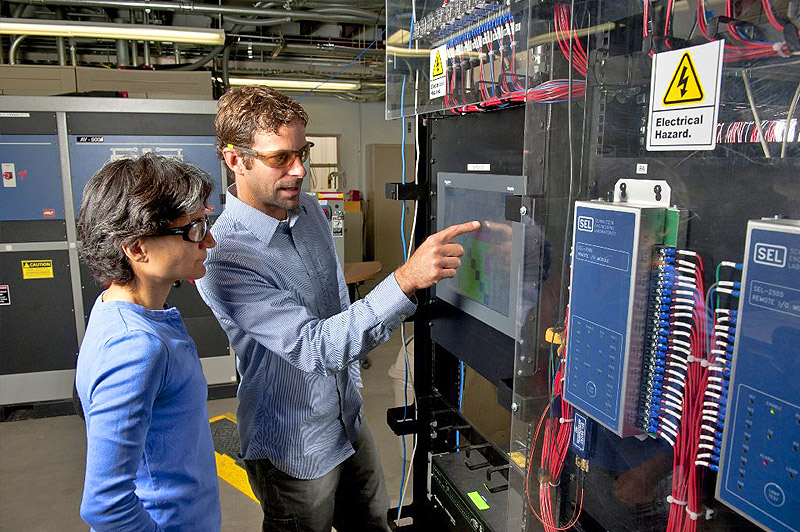
Photo of two NREL staff looking at display equipment. Enlarge image
While very reliable today, the U.S. electricity grid is old and has gone at least five decades without a significant technological upgrade. There are two prongs to the microgrid work at NREL: innovative research and partnering with industry.
Credit: Dennis Schroeder
Most Americans don't have to think much about energy reliability. We plug in a computer and it powers up; we flip a switch and the lights come on.
While very reliable today, the U.S. electricity grid is old and has gone at least five decades without a significant technological upgrade. The U.S. Department of Energy's (DOE) National Renewable Energy Laboratory (NREL) is working with industry on one solution to help maintain a secure, reliable flow of energy: microgrids.
A microgrid is a smaller power grid that can operate either by itself or connected to a larger utility grid. Microgrids can serve areas as small as a few houses, all the way up to large military installations.
"If your home was part of a microgrid, you could continue to receive power even when the utility power goes out," NREL Electrical Engineer Mariko Shirazi said. "It gives you the ability to ride through any disturbances or outages by seamlessly switching over to locally generated power."
It's important to note that a backup power system — like a diesel generator — is not the same as a microgrid. Backup generators supply power to local loads in the event of an outage, but there is usually a delay or blip when you lose power and disconnect from the utility grid before the backup kicks in. In addition, a backup system is never meant to run continuously, nor to put power into the grid. However, the reverse is true — a microgrid can serve as a backup power supply.
A microgrid senses the quality of the power flowing through the grid. In the event of an outage, it can disconnect from the grid at a moment's notice. It can also leverage solar, wind, or stored energy to supplement a dip in the current power supply. If things are running smoothly with the regional grid, a microgrid generating electricity from renewable sources can export that clean energy to the grid for everyone's use.

Just Connect and Go?
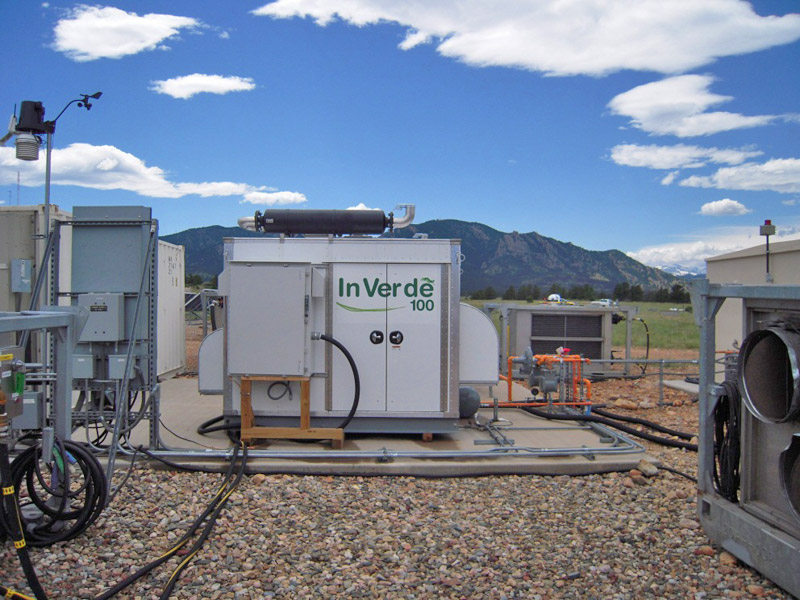
Photo of microgrid equipment.Enlarge image
As part of its microgrid research, NREL recently worked with the Sacramento Municipal Utility District to test microgrid-ready natural-gas generators at the Distributed Energy Resources Test Facility.
Credit: Connie Komomua
The major components of a microgrid include a source of power generation, local loads, and electrical switching gear. It might also include inverters and energy storage — all of which sounds easy enough to just connect up to get started, right?
"These technologies are in different stages of maturity; the challenge is to get them all to operate together in a stable, concerted way to accomplish the goals of efficiency, security, and energy reliability — all of which are required from a microgrid," NREL Electrical Engineer Greg Martin said.
There are two prongs to the microgrid work at NREL: innovative research and partnering with industry.
NREL works with industry to test microgrid systems by providing the experts as well as the infrastructure to support microgrid testing. The U.S. Department of Defense is also working with NREL researchers to examine using microgrids to improve base reliability. Testing includes using grid simulators, load banks, and generators, all currently at theDistributed Energy Resources Test Facility at the National Wind Technology Center near Boulder, Colorado.
"We use equipment such as a grid simulator to create a virtual electric grid to test equipment that is planned to be connected to a utility," Martin said. "We create outages, or some other kind of electrical phenomenon, to make sure the equipment operates as expected. We basically try to make stuff work while making sure it works the way it's supposed to."
"Utilities need to be shown that this technology is safe to integrate into the system and won't affect the normal operations," NREL Energy Systems Integration Director Ben Kroposki said. "One of the goals at NREL is to provide that test bed for a variety of scenarios to be run so that utilities can see that the risk is being reduced."
An example: take a 200-kilowatt microgrid in a residential area with 100 kilowatts of photovoltaics (PV) installed on homes. When all the homes are grid-connected through a local utility, those 100 kilowatts of PV are no big deal. But once the homes are disconnected from the grid, that's a high ratio of PV. Researchers work with industry to figure out which resources have to be maintained to keep the power reliability needed for critical loads. Key questions include, should the homes start shedding loads if a cloud crosses the sun and the PV power drops? Or is energy storage needed, so when a cloud comes, the power supply stays consistent?
NREL is leading the way in understanding issues in energy systems integration and helping industry work through them. The lab's research tools will get a boost when the Energy Systems Integration Facility (ESIF) is completed later this year.

Taking Research to the Next Level
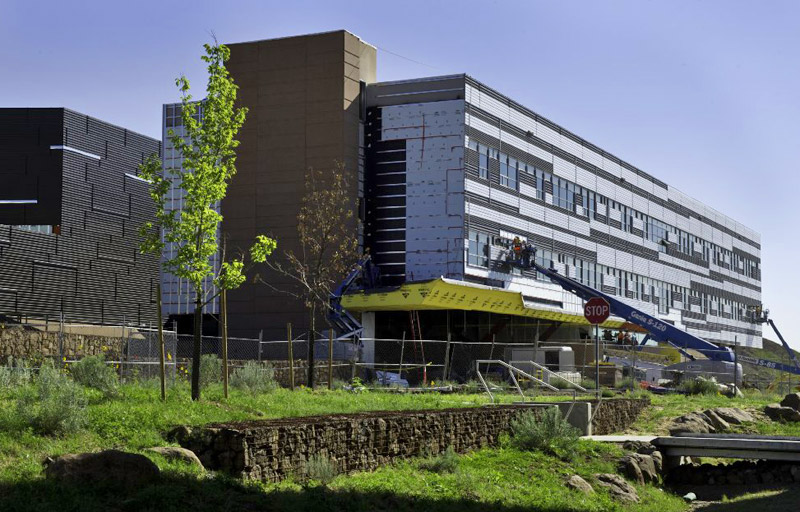
Photo of the Energy Systems Integration Facility building under construction.Enlarge image
NREL is leading the way in understanding issues in energy systems integration and helping industry work through them. The lab's research tools will get a boost when the Energy Systems Integration Facility is completed later this year.
Credit: Dennis Schroeder
"ESIF is going to be like our current lab on steroids, and will expand our testing scale to 1 megawatt," Martin said. "We'll be able to test large single components like large utility-scale inverters. We'll also be able to scale up the complexity of our testing. Using the Research Electrical Distribution Bus [REDB], and hardware-in-the loop, we'll be able to connect dozens of sources and loads and be able to test their interactions with each other. Now, we collect single data points. At ESIF, we'll be able to collect high-speed, time-synchronized data at numerous points throughout the REDB."
Using a high-performance computingPDF data center, NREL will be able to simulate entire distribution systems. When testing a microgrid system, engineers can monitor its voltages and frequencies at the point where it joins the distribution system, enabling them to simulate the effect of a microgrid on the larger utility. This is important, because being physically connected to the grid is often not practical — plus, the utility doesn't have to worry about putting an unproven technology on their system.
"Utilities see this as a growth area, and they would like to understand it," Shirazi said. "Even if they aren't implementing a microgrid themselves, they may want to understand how it works for those customers who do want to install one on a section of their distribution system. Working with NREL helps them implement this type of system without impacting their customers."
NREL's grid simulators make this testing possible without hooking up the equipment to the regional utility grid — which would be prohibitively tricky. First, researchers would need the foresight to know when voltage anomalies were going to happen, and assuming they could catch them, there would be only one chance to test equipment. With grid simulators, researchers can create voltage and frequency anomalies and see how the system behaves.
"ESIF is going to give us more research power, both in the actual electrical power but also in the ability to collect data across all points in the system," Martin said. "It will also offer really awesome visualization that will enable us to look at data coming in from different places, to look at simulations and video feeds, in a really nice, easy, big way. We're sure this visualization capability will help ignite collaborations among NREL, industry, utilities, academia, and government agencies."
"ESIF is really going to move us forward to the next generation of power systems in this country," Kroposki said. "There is consensus that our utility grid is aging and that we can get benefit out of making it more intelligent, efficient, and capable of accepting more sources of energy."
— Heather Lammers


Posted originally by NREL. Please follow us on Twitter and "like" us on Facebook!

Thursday, September 27, 2012

NREL: 35 Years of Clean Energy Leadership


National Renewable Energy Laboratory

NREL Newsroom

NREL: 35 Years of Clean Energy Leadership

Thirty-five years ago, when President Jimmy Carter opened the Solar Energy Research Institute (SERI) in Golden, Colorado, gasoline cost 62 cents a gallon, and solar power about $100 a watt.
Now, in the summer of 2012, the price of gasoline at the pump is $3.89 per gallon, the installed cost of solar power about $4 a watt.
That's a six-fold increase in the cost of gasoline, and a 95% reduction in the cost of solar. And with solar and wind energy growing by about 35% a year, and biofuels burgeoning, the laboratory in Golden is more vital than ever.
After 14 years as a solar institute, SERI achieved national lab status in 1991 under President George H. W. Bush. SERI became NREL, the U.S. Department of Energy's (DOE) National Renewable Energy Laboratory.

35 Years of Innovations, Breakthroughs, Discoveries

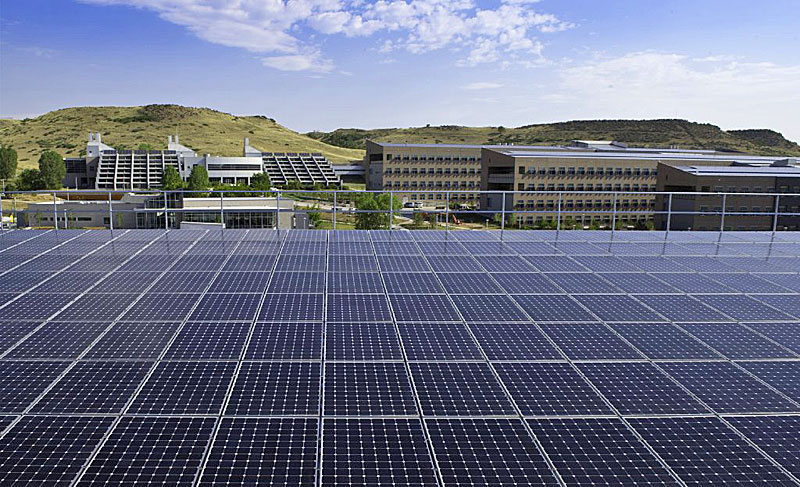
Photo of solar panels in the foreground with the NREL campus in the background, along with the grassy mesas beyond.Enlarge image
NREL's 327-acre main campus got an infrastructure boost in 2006 and 2007 when projects in the pipeline were accelerated. On the right, beyond the solar panels, is the Research Support Facility, recently tagged as the top net-zero energy building in the world.
Credit: Dennis Schroeder
What a 35 years it's been.
From its start on July 5, 1977, to today, NREL has pushed the boundaries of what's possible, leading the way to a clean energy future.
Wind turbines have grown from farmhouse curiosities to multi-megawatt behemoths.
NREL scientists inaugurated the era of the super-efficient multi-junction solar cell and combined those cells with lenses that concentrate the sun's rays by 500 times to multiply the power of photovoltaics.
The laboratory worked with industrial partners to lower the price of enzymes used to refine alternative biofuels by 97%.
And NREL scientists found ways to get two electrons from a photon of light; discovered a cost-effective way to virtually eliminate wasteful reflection off a solar cell; helped engineer an economic way to place transparent solar cells in window glass; engineered ways to get biofuels and hydrogen from algae; mapped renewable energy resources in dozens of countries; came up with new standards for aerodynamic wind turbines and concentrating solar power; and set the bar higher for sustainable buildings.
NREL researchers have won 52 R&D 100 awards — the "Oscars of Invention." That places NREL among the top national labs in R&D 100 awards per employee. Just this year, NREL won two: one for the highest-efficiency solar cell, and another for a revolutionary new type of air conditioning that uses 75% less energy than typical systems and can work in any climate.

From Rented Space to the Laboratory of the Future

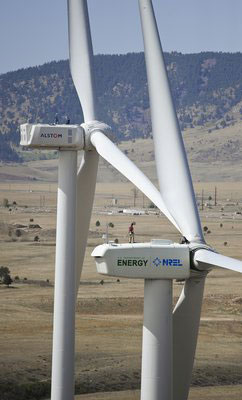
Photo of a giant wind turbine, with a man standing on the turbine's nacelle.Enlarge image
NREL's National Wind Technology Center hosts giant turbines, which manufacturers throughout the world bring to the site for testing and certification.
Credit: Dennis Schroeder
From its origins in rented office space, NREL has expanded to a 327-acre campus that is a model for what a sustainable, green office park can look like.
"When I bring visitors on the site, I often tell them that when I came to SERI, this site was 300 acres of nothing but sage brush and rattlesnakes," said Stan Bull, NREL's former associate director for Science and Technology. "But look at it now."
Today, the NREL campus is a living model of sustainability, hosting hundreds of architects, planners, and lawmakers each year, along with a multitude of scientists from around the world.
It wasn't always so.
"The people who joined SERI early, who suffered through the great swings of support and inattention in the 1980s, were like monks in a monastery keeping the candle of hope and dedication burning while nobody else cared," said Art Nozik, an NREL senior research fellow emeritus whose breakthroughs on singlet fission opened the door to greater solar cell efficiency. "Today, when the awareness and importance of our mission is understood and appreciated by a large fraction of the world's population, we can be confident that we can move forward at an accelerated rate to help our society and planet to survive and flourish."
Ron Judkoff arrived in 1978, as the organization's first building energy efficiency scientist. "Back then, we were all in rented space, and when NREL built its first major building on campus, the Field Test Laboratory Building, no one thought to invite our small group of building energy efficiency scientists and engineers into the process," recalled Judkoff, who is now NREL's principal program manager for building energy research. "In fact, most of the staff and management probably thought the term 'building science' was an oxymoron."
Last month, Construction Digital, a monthly online magazine, named NREL's Research Support Facility (RSF) — a 326,000-square-foot building housing 1,300 employees — the top net-zero energy building in the world. "Net zero" means the building uses no more fossil-fuel-based energy in a year than it makes up for in on-site renewable energy. In all, the RSF has received more than 30 awards for sustainable design and construction.
Now, with several buildings that have achieved lofty LEED (Leadership in Energy and Environmental Design) status, the technologies developed by NREL and its industrial partners are found on the campus and in the world market. The "SolarWall" transpired collectorlight louvers, electrochromic and thermochromic windowsthermal storage walls, and NREL's Open Studio software tools that simplify optimal energy design, are getting friendly receptions in the marketplace.
"I expect the awards to keep coming, and our campus to serve as a shining example of energy efficiency throughout the world for many years to come," Judkoff said.

Origins Traced to 1970s Oil Embargo

Photo of the sun hitting a medallion on the floor of a building at NREL.Enlarge image
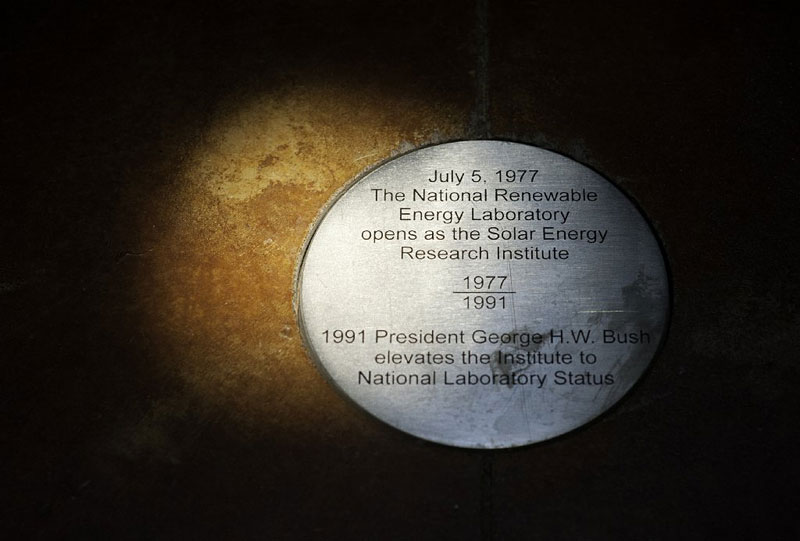
The sun hits the commemorative medallion on the floor of NREL's Science and Technology Facility (S&TF) at solar noon on July 5, 2012. The medallion was placed in the S&TF in 2006 to commemorate the anniversary of the lab in 1977, and the day in 1991 when President George H.W. Bush elevated the institute to National Lab Status.
Photo by Dennis Schroeder / NREL
SERI was approved by Congress and championed by President Carter in large part because of the oil embargo that pushed the price of gasoline from about 36 cents a gallon in 1972 to 62 cents in 1977.
From a focus on solar energy, NREL has grown to also include cutting-edge breakthrough research in wind, biofuels, energy efficiency, transportation, and geothermal energy.
Walt Musial was hired in 1988 as a testing engineer at a time when many of the U.S. wind power companies were going bankrupt because of canceled tax credits.
"The industry was moving to Europe, and NREL's National Wind Technology Center [NWTC] was one of the last safe havens where good-quality research was being done to explore big problems still facing the technology," Musial recalled.
NREL's wind center became the go-to site for companies, both foreign and domestic, to test their turbines and blades in the wind blowing down from the foothills of the Rocky Mountains and in the NWTC's dynamometer.

Not Just a Research Lab, but a Factor in the Marketplace

This photo shows two men in white lab coats amid gleaming silver machinery with hoses heading to an unseen ceiling. Enlarge image
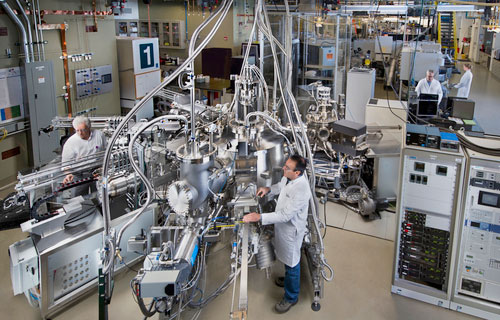
Two scientists work on a project to enhance the efficiency of thin-film solar cells at NREL's Process Development and Integration Laboratory, which helps private companies boost the performance of their cells and modules.
Credit: Dennis Schroeder
In its early years, SERI/NREL was a research lab that didn't involve itself in the realities of the marketplace. That changed in the early 1990s as NREL reached out to industry to help turn science into technology, working with the private sector to ramp up and bring renewable energy and energy efficiency to market.
Many of today's top solar companies percolated their ideas in the DOE Incubator program run at NREL.
NREL has been issued 262 patents and has agreements with 305 industry partners, 64 universities, and 33 not-for-profit organizations. It currently has 116 Cooperative Research and Development Agreements (CRADAs) with industry.

An International Reach; a Helping Hand in Disasters

NREL's reach spreads across five continents — from wind and solar studies in Indonesia to biofuel-powered vehicles in Antarctica.
NREL's Roger Taylor and Dick DeBlasio recall that in the wake of the Earth Summit in Rio de Janeiro in 1992, they implemented the first stage of what later became a Brazilian national program to deploy solar and small wind power systems in communities without electricity in rural Brazil. "Luz para Todus" (Light for All) became a multi-year rural electrification program after the installation of more than 100 lighting, water pumping, and health clinic systems. "Our work in Brazil was very rewarding and fun," said DeBlasio, a chief engineer. "I started here in May of 1978, but it seems like yesterday."
NREL scientists and engineers have helped rebuild communities devastated by hurricanes, floods and tornadoes — showing how to bring sustainable energy and architecture to cities and towns, from tornado-ravaged Greensburg, Kansas, to New Orleans, flooded in the wake of Hurricane Katrina.

Renewable Energy's Growth Has Exploded

In the 35 years that NREL has led the way to a clean energy future, renewable energy has exploded:
  • Installed renewable energy tripled between 2000 and 2009 in the United States and globally.
  • While renewable energy comprised 2% of all new electrical capacity installations in the United States in 2002, by 2009 renewable energy comprised 55% of all new installations.
  • Installed wind energy capacity increased by a factor of 14 between 2000 and 2009 in the United States.
  • The weighted average price of wind power in the United States fell to 4.4 cents per kilowatt hour, making it cost competitive with fossil fuels.
  • The United States leads the world in wind energy capacity at more than 35 gigawatts.
Just in the past decade, solar energy generation quadrupled in the United States. The annual growth rate of installed solar photovoltaic electricity capacity was 39%, while wind energy capacity grew by 34% a year.
Bull recalls the early days as "a mixture of wild-eyed hopes and utter disappointment," as the lab at first grew rapidly, then "declined precipitously overnight" when half the staff was laid off. Now, more than 2,000 people are employed at NREL.
"SERI/NREL has been and I think always will be a special place because the staffers have such a deep-seated dedication and commitment to the vision and mission," Bull said. "Just the name NREL is an incredible 'door opener' both nationally and internationally. It's almost frightening at times the impact the name alone has on acceptance in the world of energy."
Learn more about NREL's 35 years of innovationPDF.
— Bill Scanlon


Posted originally by NREL. Please follow us on Twitter and "like" us on Facebook!
Tuesday, September 25, 2012

Thermal Scout Finds Trouble at Solar Plants


National Renewable Energy Laboratory

NREL Newsroom

Thermal Scout Finds Trouble at Solar Plants

In this photo, a red pickup rumbles alongside a row of parabolic-shaped mirrors while the upside-down reflection of the truck is visible along the upper sections of the mirror.Enlarge image
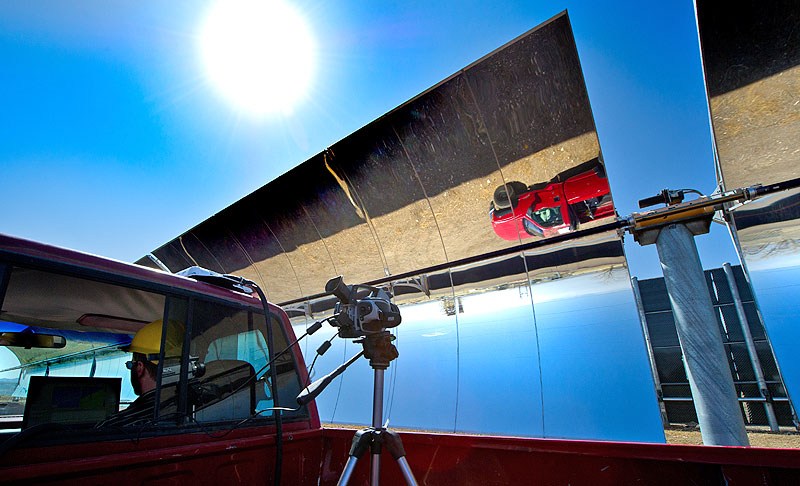
At SkyFuel Inc.'s testing facility in Arvada, Colorado, NREL Engineer Allison Gray drives a pickup truck equipped with Thermal Scout, a device that teams a GPS unit on the roof with an infrared camera in the pickup bed. NREL colleague Benjamin Ihas checks the readings on a laptop to the right of the driver's seat.
Credit: Dennis Schroeder
At a 20-megawatt concentrating solar power (CSP) plant, some 10,000 mirrors reflect sunlight onto 10,000 receiver tubes, each of which must operate efficiently to get the maximum impact from the sun.
Yet, operators don't have a good sense for which among the 10,000 tubes may have an air leak, or a hydrogen leak, or have been shattered by a flung rock. The best they can do is look at the entire output and roughly guess that if the plant seems to be operating, say, 4% under capacity, it may have about 400 bad tubes.
The only alternative is to laboriously check each tube by hand, an odyssey that can take months.
Now, the U.S. Department of Energy's (DOE) National Renewable Energy Laboratory (NREL) has available for license a device called Thermal Scout that can identify and analyze bad receiver tubes as fast as a car or truck can rumble down the rows of mirrors at a CSP plant.
Thermal Scout combines a global positioning system (GPS) on the roof of a car, an infrared camera in the back seat, and some sophisticated software that tracks and analyzes in real time. All the driver has to do is push a couple of buttons, then drive in a very straight line down the rows while Thermal Scout does all the rest of the work.
For the 40 multi-megawatt CSP plants in the world today — and the 28 new ones slated to be built by 2014 —Thermal Scout could mean turning a months-long task into a two-day sprint.

Need for Rapid Detection Device Spurred Invention

This is an extreme close-up of the lens of an infrared camera, with the mirrors it is pointing at clearly visible in the lens's glass.Enlarge image
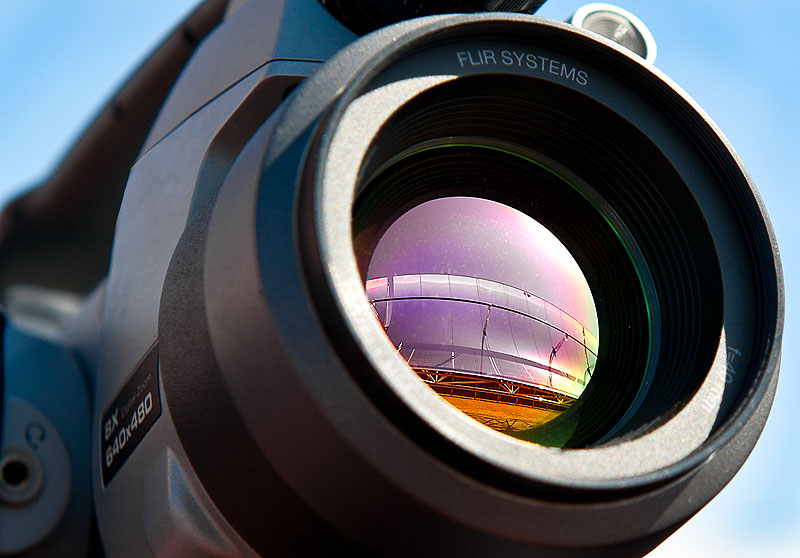
The infrared camera used in Thermal Scout can identify and analyze bad receiver tubes at the speed at which a truck can rumble down the rows of mirrors at a CSP plant.
Credit: Dennis Schroeder
NREL Senior Engineer Tim Wendelin started working on the concept a decade ago when leaders in the parabolic trough industry explained to him the importance of being able to characterize the performance of their receivers in the field.
Wendelin combined an infrared camera with a precise GPS unit and software to produce a device that provided shortcuts to the old, labor-intensive method of checking each tube manually. But it was still cumbersome.
He credits his NREL colleagues Allison Gray and Benjamin Ihas with bringing real-time analytics and user-friendliness to the device, which they dubbed "Thermal Scout" in 2011.
"They brought it into the 21st century," Wendelin said. "Now, it is so smooth and easy to use."
At a CSP plant, the sun strikes mirrors that heat up a fluid that turns water into steam to turn turbines that generate electricity for homes and buildings. The heating fluid is enclosed in a black-coated stainless-steel tube — the receiver. The receiver is surrounded by a glass tube and a vacuum that minimizes thermal loss. The infrared camera in Thermal Scout focuses on that glass tube.
The GPS device ensures that even with slowdowns or potholes, the camera captures the image of that glass tube as the vehicle wheels down the row of receivers.
The tube-shaped receivers are typically about 4 meters — or 13 feet — long and about 70 millimeters — or 3 inches — wide. In a typical CSP plant, there might be 100 receivers in a row, and some 100 or 200 rows.
"The beauty of Thermal Scout is that it's used in a consistent geometry," Wendelin said. "The receivers are all in rows, and it can snap a shot of each one of them."
Receivers are designed to last for decades, but something as simple as a rock sent flying by a passing vehicle can compromise the tubes and let in outside air. Or, the thermal fluid that passes through the tube can degrade over time, causing a buildup of hydrogen between the steel tube and the glass. Earlier generations of receivers weren't built quite as well and may have shorter lifetimes compared to today's receivers.

Thermal Scout is User-Friendly

This photo shows three people in yellow hard hats looking at a laptop computer screen, with parabolic mirrors in the background.Enlarge image
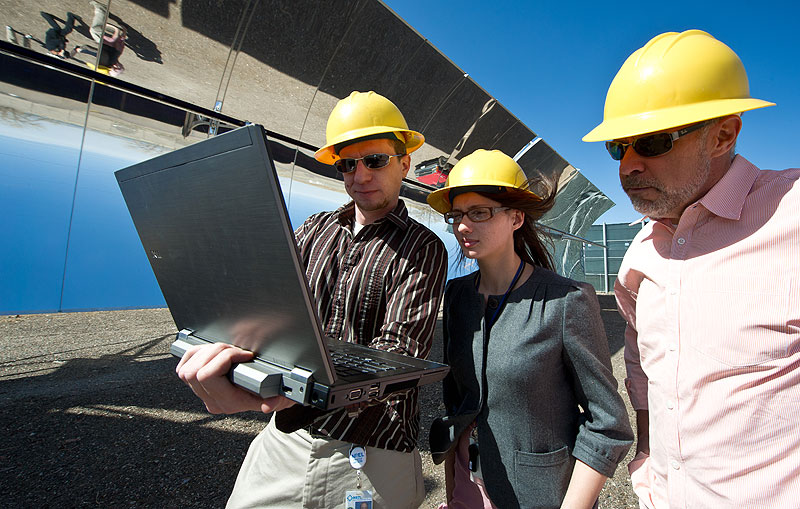
NREL Senior Engineer Tim Wendelin, right, started working on the concept of Thermal Scout a decade ago to try to characterize the performance of the receivers in a CSP plant. NREL engineers Benjamin Ihas, left, and Allison Gray, center, enhanced the concept and made it user friendly.
Credit: Dennis Schroeder
Thermal Scout users start with NREL-developed software that asks them to define the row geometry and specify the number of rows, something they only need to do once. Users also need to input the temperature of the fluid as it enters a row of receivers and its (higher) temperature when it reaches the end of the row.
Armed with that information, the infrared camera — with the help of the GPS — knows when to snap to capture thermal images of each receiver.
The GPS device is on top of the car, the infrared camera mounted on a tripod in the back seat.
The driver clicks "Start Test," the software fine-tunes the camera to get the right focus, and the driver starts moving.
Thermal Scout can operate well at 25 mph, but most plants have a 10-mph speed limit to keep road dust from landing on the mirrors or receivers.
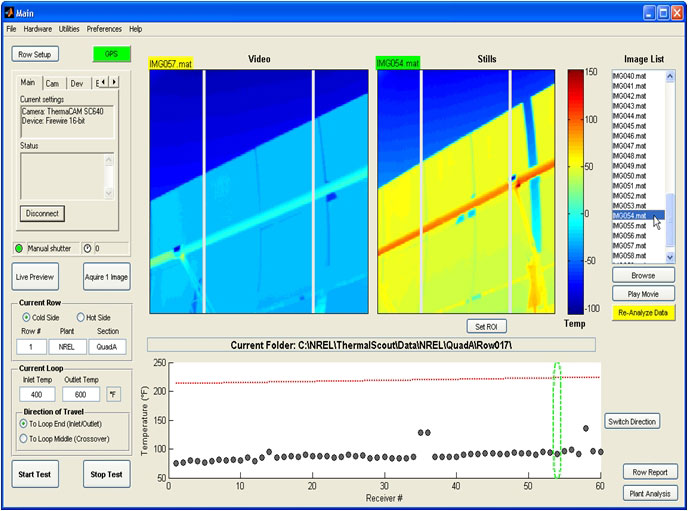
If a passenger is interested, he or she can watch a video on the left side of the screen and still images on the right. At the bottom is a real-time plot of the average of the peak temperatures.
"The software will find the highest peak temperature, which in our case is always the receiver tube," Ihas said. "It can take 100 slices and run a statistical analysis to make sure there are no strange artifacts giving a false reading."
For example, if the camera captures a metal joint or the sun's reflection on the bottom of the tube, eliciting a temperature way above the norm, that anomaly is filtered out of the equation.
Later, when plant operators analyze the data, they can see, for example, that receiver 35 in row 12 showed some higher temperatures. They can retrieve the images from that specific receiver and verify — or not — that the tube is indeed malfunctioning or running a little warmer.

Device Helps Operators Determine When to Replace Receivers

This is a screen shot of the data collected by Thermal Scout. At the top left is a video mostly in blue that shows the sky, the mirrors, and the thin receiver tube going through the center of the mirrors. At the top right is a still shot of the same scene, but with the mirrors in yellow and the tubes in orange. On the lower part of the screen is a chart with dots, each representing a receiver tube. Most of the dots are positioned between 50 and 100 degrees Fahrenheit, but a few are above 100 degrees, indicating they may need to be replaced.Enlarge image
Thermal Scout's data acquisition interface. The left screen is a video image with the mirrors in blue and the tube in lighter blue. On the right is a still shot with the tube in orange. Below, a series of dots shows which tubes are at an elevated temperature. Data can be read in real time or saved to be analyzed later.
Credit: Dennis Schroeder
The latest enhancement of Thermal Scout is built-in data analysis, which has been streamlined and made intuitive for users. 
Click for a row report in Thermal Scout, and a Web page is generated that can be shared with anyone at the plant. Click to "acquire one image," and that image can be examined in detail, now or later.
Another click, and a complete data analysis for a row, a series of rows, or the entire plant appears on the screen.
"Thermal Scout can very quickly identify a hot receiver, including the row, the number, the glass temperature, and where to find it," Ihas said.
Every line of pixels is a line of data, Gray, an NREL engineer, noted. And NREL can help troubleshoot problems remotely.
Of course, it's up to plant operators to decide when to replace the problematic receivers — when a few are bad, or when dozens or hundreds are bad. A row of receivers can be shut down overnight, and a few replaced by the time the sun rises the next morning. Still, it's a laborious job, so the plant uses its own discretion on what failure rate warrants replacement of receivers.
A recent test of a five-year-old plant found that about 5% of the receivers were performing poorly or starting to waver, Ihas said.
"Thermal Scout would likely be used every two years or so at a large CSP plant, unless something happened to the output that warranted more frequent checks," Gray said.
"There's probably a threshold where they would say, 'We need to address this; we need to replace some receivers,'" Wendelin added.
Florida Power and Light, which installed early-generation CSP receivers, used an early version of Thermal Scout several years ago to quickly assess their tubes and determined that it made the most fiscal sense to replace them all. "They never would have been able to make that determination without Thermal Scout," Wendelin said.
Learn more about NREL's concentrating solar power research.
—Bill Scanlon


Posted originally by NREL. Please follow us on Twitter and "like" us on Facebook!
Thursday, September 20, 2012

NREL Helps PV Industry Make Panels Last


National Renewable Energy Laboratory

NREL Newsroom

NREL Helps PV Industry Make Panels Last

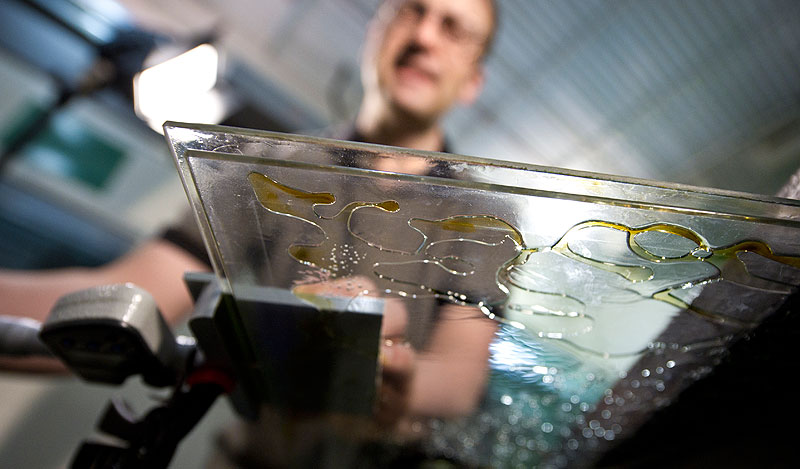
In this photo, a scientist is using a calibrating instrument to measure the distance that one glass panel has separated from another. Between the glass panels, a glue-like substance has turned to liquid and is oozing yellow.Enlarge image
Working in his lab at the NREL Outdoor Test Facility, NREL scientist Michael Kempe measures the "creep" of the top and bottom glass of a solar module, testing the encapsulant and demonstrating how enough stress can produce a spectacular failure.
Credit: Dennis Schroeder
During 30 years on a rooftop, a solar panel gets bombarded by UV rays, soaked by rain, buffeted by wind, pounded by hail.
How well it stands up to that beating is a crucial factor in setting the warranties of solar modules — and in convincing the public that solar energy can be counted on like the sun rising in the east.
The U.S. Department of Energy's (DOE) National Renewable Energy Laboratory (NREL) plays a crucial role in improving the reliability of the photovoltaic (PV) panels that are being installed on rooftops in record numbers.
NREL helps set standards for reliability and serves as a neutral third party in tests of manufacturers' new solders, edge seals, and glues. At its Golden, Colorado, campus, NREL subjects solar panels to heat, humidity, and mechanical stress to simulate conditions in Denver, Phoenix, the Philippines, and elsewhere.
In March, leading scientists and engineers in the industry gathered at NREL for the PV Module Reliability Workshop. The workshop encouraged a frank discussion of reliability problems that can plague solar power companies.
What standards are needed for the glue in the edges that seal a panel's top and bottom? How does weather affect cracking? What can be done to prevent one glass panel from creeping away from the other?
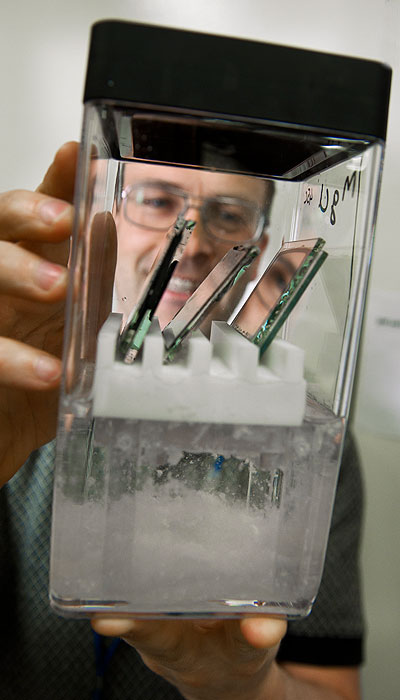
This photo shows a scientist holding a see-through container that holds three glass squares above a solution of whitish semi-solid salt.Enlarge image
NREL scientist Michael Kempe holds PV samples he is exposing to a saturated salt solution to control humidity. The samples are being tested for possible failures.
Credit: Dennis Schroeder

NREL Stresses Edge Seals to Predict Failure

Solar modules must be sealed to keep out moisture — and that's why edge seals are so crucial.
NREL scientist Michael Kempe exposes edge seals to different configurations and environments using Atlas Weather-Ometers.
On what looks like a whirling see-through geodesic dome — albeit just two feet in diameter — NREL scientists attach matchbook-sized samples that simulate the construction of PV modules to determine at what combination of UV radiation, high temperature, high humidity, and mechanical stress those samples can fail.
It's important that manufacturers not just check for single stresses. By demonstrating that a combination of two or three factors can cause a failure, NREL is helping manufacturers prepare for the worst.
"We help manufacturers to know what kind of stress to put on their samples to determine if Sample A is better than Sample B," Kempe said. "Every tiny detail, every aspect of these things has to be examined."
A typical 12-millimeter-wide edge seal should keep out moisture anywhere in the world — from Salt Lake City to Bangkok — if it maintains a good adhesion, Kempe said. And the cost is between $1 and $2 a module, whether it is a tape-style edge seal or a hot-melt extrusion.
For humidity tests, NREL uses a vacuum oven to expose samples to controlled relative humidity using saturated salt solutions: lithium chloride for low humidity; magnesium chloride for 25% to 31% humidity; sodium nitrates for higher humidity.

Testing Leads to Good News on Panel Creep

This is a close-up of a square and a rectangular sample held in a hand. The rectangular sample shows failure in the form of black globs invading the transparent center.Enlarge image
NREL scientist Michael Kempe holds PV samples he is testing for edge seals in an Atlas CI 4000 Xenon Weather-Ometer. The machine is used to give mechanical, light, heat, and humidity stress to PV samples.
Credit: Dennis Schroeder
NREL has been able to share good news with the industry.
In the case of "creep," NREL's sophisticated tests showed that the problem isn't as big as was feared.
In a solar module, two pieces of glass are adhered together with a plastic encapsulant that may be solid at one temperature but flow — or "creep" — at another temperature. If it flows during the expected lifetime of a solar module, solar panel components can be displaced, and that can cause a short, break electrical connections, or even cause fires.
The stakes are high: a one-centimeter creep can expose live wires to the elements, and that can cause arcing or other serious safety problems.
NREL's tests found that most encapsulants used today or proposed for future use do a very good job of preventing creep. But showing that failure is possible keeps manufacturers from becoming complacent.
Last summer, Kempe and his colleagues used eight different encapsulants from six manufacturers to assemble several mock and actual solar modules. The scientists then evaluated them side by side in an objective manner, and in a way that uncovered strengths and weaknesses of the various encapsulants without pointing fingers at individual companies. The industry's trust in NREL made the tests possible. "They were able to participate without the fear of being singled out," Kempe said.
The researchers put insulating materials on the test modules and deployed them in Arizona so they would reach the highest temperatures (104°C) that are likely in the field.
The only material that crept significantly in the outdoor experiments was one that was intentionally formulated improperly so that it would still melt at moderate temperatures.
"All the other plastic materials that people in the industry were considering for encapsulation were essentially OK outdoors," Kempe said. "It would only be under very extreme circumstances that you might have a problem. The standards community realized that this stumbling block was not nearly as big an issue as was suspected."

Stress, Temperature Tests Help Prevent Cell Overheating

In this close-up of a weatherization instrument, a gray spindle is in the foreground, and red and clear samples, looking like the windows on a geodesic dome, are in the background.Enlarge image
Shown here is a close-up of the inside of an Atlas CI 4000 Xenon Weather-Ometer used to test small samples of solar panels. NREL scientists apply temperature, humidity, and mechanical stress to the samples to show industry how they can fail.
Credit: Dennis Schroeder
NREL also works on the problem of concentrating PV cells overheating in a module. Concentrating PV uses lenses to focus more sunlight on a solar cell. The solder or epoxy that adheres the panel's glass and edges will fatigue with time because of temperature changes that happen with the weather, NREL scientist Nick Bosco said. When the attachment goes bad, heat can't escape, and the cell overheats.
NREL uses high-frequency weather data to model the changes in cell temperature for Houston, Los Angeles, Albuquerque … wherever a company wants a climate test. The data are publicly available.
The most damaging locales are those with high temperatures and partly cloudy skies. The frequent temperature changes when clouds pass by can cause extra stress. "In Golden, Colorado [site of NREL's main campus], where we get hot mornings and then clouds roll in every afternoon, that can be more damaging than in Phoenix where you don't have many clouds," Bosco said. "We're early in the process, but we're seeing easily a 20% to 40% difference between certain locations."
To test the effect of temperature cycles on the modules, NREL uses various solders and epoxies to attach pieces of the panels, and then exposes them to different temperatures at varying intervals. Researchers test thermal cycling in indoor chambers and expose modules to outside conditions, comparing the results.
"We're interested in how cracks grow in the solder as the module goes through cycles," Bosco said. "Our instruments can image the cracks on a computer, analyze them, and measure their size. We'll do that periodically, then put the module back in the chamber, do more cycles, then measure the growth rate of the cracks as a function of the number of cycles."
Bosco is working on models and experiments to determine the amount of damage the attachment will accumulate. The goal is for the indoor test chamber to accurately reflect outdoor conditions.
"The amount of damage the attachment accumulates is different for every city, and we're hoping to model that," Bosco said. "We're hoping to be able to make real-life predictions based on location." So many cycles in the chamber is equal to so many years outside. "So, a company might expect similar crack growth after so many years."
The challenge for industry is to design solar modules that are very durable and reliable, yet not overly expensive. NREL scientists and their industry counterparts agree they can meet that challenge.
"They're looking for a route to a less expensive design and architecture of a cell assembly," Bosco said. NREL is able to figure out why a solution works, not just that it does work. It can report that a change in design or materials has this or that consequence in reliability. And NREL shares that knowledge with the industry to help the technology move forward.
NREL scientists and their industry partners have learned that an accelerated test will mean different things in different locations — and that the material and architecture of the design can influence reliability dramatically. "You can certainly have an expensive bad design," Bosco said. And, of course, a good product that is incorrectly installed can fail.
As tempting as it is to accelerate the testing so that new, presumably better products can get to market sooner, testing experts know that validating a product for 20 or 30 years of useful life is complicated without comparisons to real-life durability.
So, NREL and the industry keep a poultry analogy in mind. "When you're trying to hatch an egg, you give it 25 days at about 40°C, and you get a chicken," Kempe said. "If you try to accelerate the time by accelerating the temperature, you get a boiled egg."
The results of NREL's testing will provide the technical basis for changes to reliability standards.
Today, the standards aren't robust enough to predict the overall longevity of solar panels. NREL, the PV industry, and the attendees of the PV Reliability Workshop are working toward the day when tests and standards can determine the lifetime reliability of a module.
"What can come out of this is a graded test sequence," Bosco said. "If you pass, say, Level A, it means the module is good for a lifetime in these certain locations. A stricter Level B certification will provide a similar lifetime warranty in more damaging locations."
Learn more about NREL's PV performance and reliability testing.
—Bill Scanlon


Posted originally by NREL. Please follow us on Twitter and "like" us on Facebook!