Translate

Showing posts with label Concentrating Solar. Show all posts

Tuesday, September 25, 2012

Thermal Scout Finds Trouble at Solar Plants


National Renewable Energy Laboratory

NREL Newsroom

Thermal Scout Finds Trouble at Solar Plants
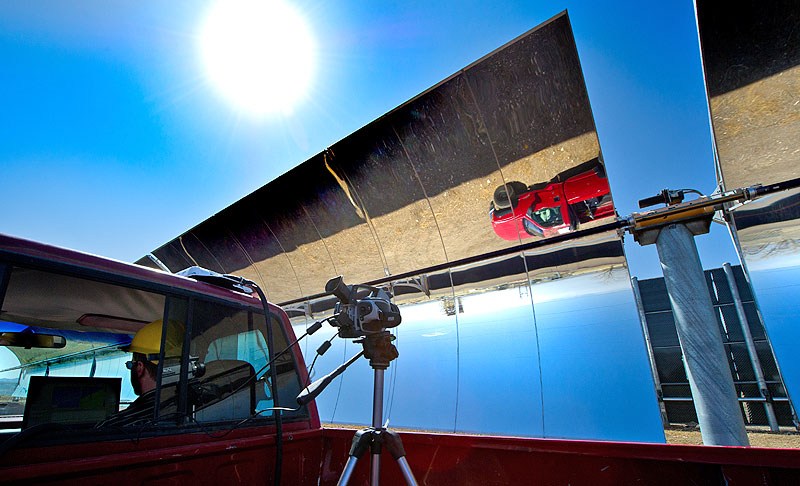
In this photo, a red pickup rumbles alongside a row of parabolic-shaped mirrors while the upside-down reflection of the truck is visible along the upper sections of the mirror.Enlarge image
At SkyFuel Inc.'s testing facility in Arvada, Colorado, NREL Engineer Allison Gray drives a pickup truck equipped with Thermal Scout, a device that teams a GPS unit on the roof with an infrared camera in the pickup bed. NREL colleague Benjamin Ihas checks the readings on a laptop to the right of the driver's seat.
Credit: Dennis Schroeder
At a 20-megawatt concentrating solar power (CSP) plant, some 10,000 mirrors reflect sunlight onto 10,000 receiver tubes, each of which must operate efficiently to get the maximum impact from the sun.
Yet, operators don't have a good sense for which among the 10,000 tubes may have an air leak, or a hydrogen leak, or have been shattered by a flung rock. The best they can do is look at the entire output and roughly guess that if the plant seems to be operating, say, 4% under capacity, it may have about 400 bad tubes.
The only alternative is to laboriously check each tube by hand, an odyssey that can take months.
Now, the U.S. Department of Energy's (DOE) National Renewable Energy Laboratory (NREL) has available for license a device called Thermal Scout that can identify and analyze bad receiver tubes as fast as a car or truck can rumble down the rows of mirrors at a CSP plant.
Thermal Scout combines a global positioning system (GPS) on the roof of a car, an infrared camera in the back seat, and some sophisticated software that tracks and analyzes in real time. All the driver has to do is push a couple of buttons, then drive in a very straight line down the rows while Thermal Scout does all the rest of the work.
For the 40 multi-megawatt CSP plants in the world today — and the 28 new ones slated to be built by 2014 —Thermal Scout could mean turning a months-long task into a two-day sprint.

Need for Rapid Detection Device Spurred Invention
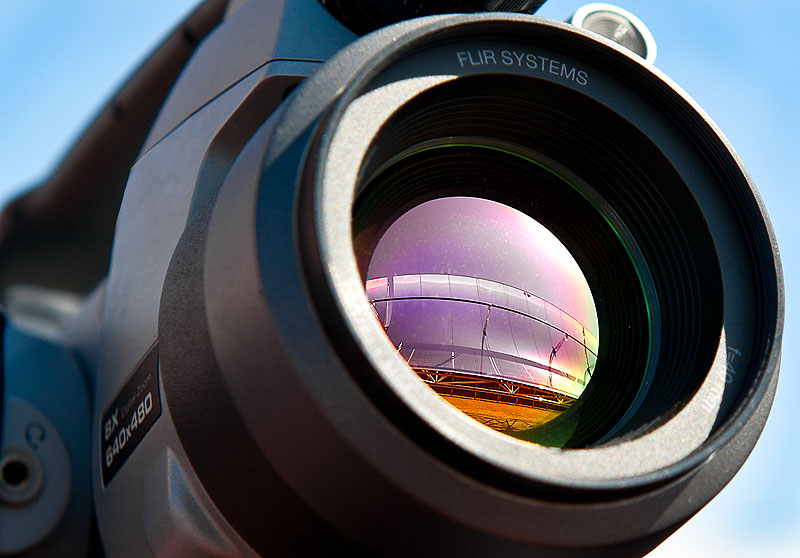
This is an extreme close-up of the lens of an infrared camera, with the mirrors it is pointing at clearly visible in the lens's glass.Enlarge image
The infrared camera used in Thermal Scout can identify and analyze bad receiver tubes at the speed at which a truck can rumble down the rows of mirrors at a CSP plant.
Credit: Dennis Schroeder
NREL Senior Engineer Tim Wendelin started working on the concept a decade ago when leaders in the parabolic trough industry explained to him the importance of being able to characterize the performance of their receivers in the field.
Wendelin combined an infrared camera with a precise GPS unit and software to produce a device that provided shortcuts to the old, labor-intensive method of checking each tube manually. But it was still cumbersome.
He credits his NREL colleagues Allison Gray and Benjamin Ihas with bringing real-time analytics and user-friendliness to the device, which they dubbed "Thermal Scout" in 2011.
"They brought it into the 21st century," Wendelin said. "Now, it is so smooth and easy to use."
At a CSP plant, the sun strikes mirrors that heat up a fluid that turns water into steam to turn turbines that generate electricity for homes and buildings. The heating fluid is enclosed in a black-coated stainless-steel tube — the receiver. The receiver is surrounded by a glass tube and a vacuum that minimizes thermal loss. The infrared camera in Thermal Scout focuses on that glass tube.
The GPS device ensures that even with slowdowns or potholes, the camera captures the image of that glass tube as the vehicle wheels down the row of receivers.
The tube-shaped receivers are typically about 4 meters — or 13 feet — long and about 70 millimeters — or 3 inches — wide. In a typical CSP plant, there might be 100 receivers in a row, and some 100 or 200 rows.
"The beauty of Thermal Scout is that it's used in a consistent geometry," Wendelin said. "The receivers are all in rows, and it can snap a shot of each one of them."
Receivers are designed to last for decades, but something as simple as a rock sent flying by a passing vehicle can compromise the tubes and let in outside air. Or, the thermal fluid that passes through the tube can degrade over time, causing a buildup of hydrogen between the steel tube and the glass. Earlier generations of receivers weren't built quite as well and may have shorter lifetimes compared to today's receivers.

Thermal Scout is User-Friendly
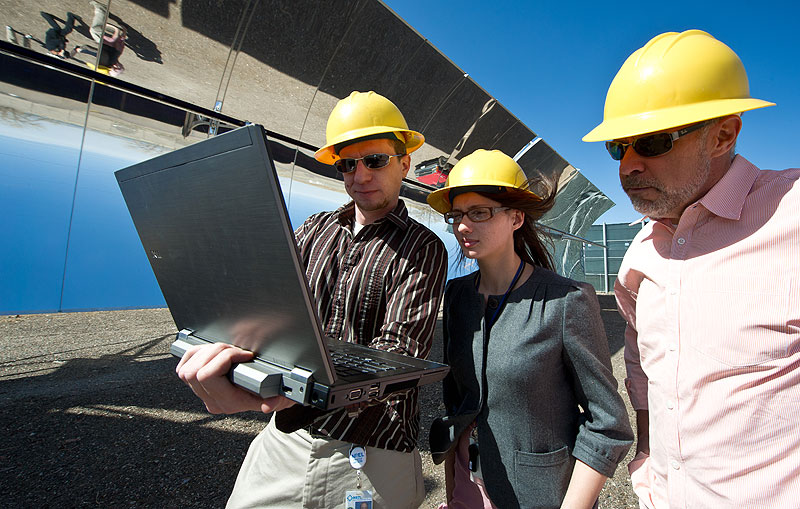
This photo shows three people in yellow hard hats looking at a laptop computer screen, with parabolic mirrors in the background.Enlarge image
NREL Senior Engineer Tim Wendelin, right, started working on the concept of Thermal Scout a decade ago to try to characterize the performance of the receivers in a CSP plant. NREL engineers Benjamin Ihas, left, and Allison Gray, center, enhanced the concept and made it user friendly.
Credit: Dennis Schroeder
Thermal Scout users start with NREL-developed software that asks them to define the row geometry and specify the number of rows, something they only need to do once. Users also need to input the temperature of the fluid as it enters a row of receivers and its (higher) temperature when it reaches the end of the row.
Armed with that information, the infrared camera — with the help of the GPS — knows when to snap to capture thermal images of each receiver.
The GPS device is on top of the car, the infrared camera mounted on a tripod in the back seat.
The driver clicks "Start Test," the software fine-tunes the camera to get the right focus, and the driver starts moving.
Thermal Scout can operate well at 25 mph, but most plants have a 10-mph speed limit to keep road dust from landing on the mirrors or receivers.
If a passenger is interested, he or she can watch a video on the left side of the screen and still images on the right. At the bottom is a real-time plot of the average of the peak temperatures.
"The software will find the highest peak temperature, which in our case is always the receiver tube," Ihas said. "It can take 100 slices and run a statistical analysis to make sure there are no strange artifacts giving a false reading."
For example, if the camera captures a metal joint or the sun's reflection on the bottom of the tube, eliciting a temperature way above the norm, that anomaly is filtered out of the equation.
Later, when plant operators analyze the data, they can see, for example, that receiver 35 in row 12 showed some higher temperatures. They can retrieve the images from that specific receiver and verify — or not — that the tube is indeed malfunctioning or running a little warmer.

Device Helps Operators Determine When to Replace Receivers
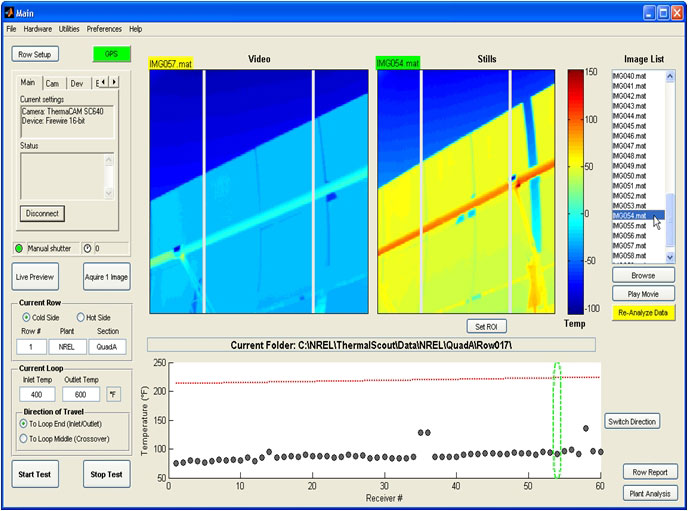
This is a screen shot of the data collected by Thermal Scout. At the top left is a video mostly in blue that shows the sky, the mirrors, and the thin receiver tube going through the center of the mirrors. At the top right is a still shot of the same scene, but with the mirrors in yellow and the tubes in orange. On the lower part of the screen is a chart with dots, each representing a receiver tube. Most of the dots are positioned between 50 and 100 degrees Fahrenheit, but a few are above 100 degrees, indicating they may need to be replaced.Enlarge image
Thermal Scout's data acquisition interface. The left screen is a video image with the mirrors in blue and the tube in lighter blue. On the right is a still shot with the tube in orange. Below, a series of dots shows which tubes are at an elevated temperature. Data can be read in real time or saved to be analyzed later.
Credit: Dennis Schroeder
The latest enhancement of Thermal Scout is built-in data analysis, which has been streamlined and made intuitive for users. 
Click for a row report in Thermal Scout, and a Web page is generated that can be shared with anyone at the plant. Click to "acquire one image," and that image can be examined in detail, now or later.
Another click, and a complete data analysis for a row, a series of rows, or the entire plant appears on the screen.
"Thermal Scout can very quickly identify a hot receiver, including the row, the number, the glass temperature, and where to find it," Ihas said.
Every line of pixels is a line of data, Gray, an NREL engineer, noted. And NREL can help troubleshoot problems remotely.
Of course, it's up to plant operators to decide when to replace the problematic receivers — when a few are bad, or when dozens or hundreds are bad. A row of receivers can be shut down overnight, and a few replaced by the time the sun rises the next morning. Still, it's a laborious job, so the plant uses its own discretion on what failure rate warrants replacement of receivers.
A recent test of a five-year-old plant found that about 5% of the receivers were performing poorly or starting to waver, Ihas said.
"Thermal Scout would likely be used every two years or so at a large CSP plant, unless something happened to the output that warranted more frequent checks," Gray said.
"There's probably a threshold where they would say, 'We need to address this; we need to replace some receivers,'" Wendelin added.
Florida Power and Light, which installed early-generation CSP receivers, used an early version of Thermal Scout several years ago to quickly assess their tubes and determined that it made the most fiscal sense to replace them all. "They never would have been able to make that determination without Thermal Scout," Wendelin said.
Learn more about NREL's concentrating solar power research.
—Bill Scanlon


Posted originally by NREL. Please follow us on Twitter and "like" us on Facebook!

Thursday, September 20, 2012

NREL Helps PV Industry Make Panels Last


National Renewable Energy Laboratory

NREL Newsroom

NREL Helps PV Industry Make Panels Last

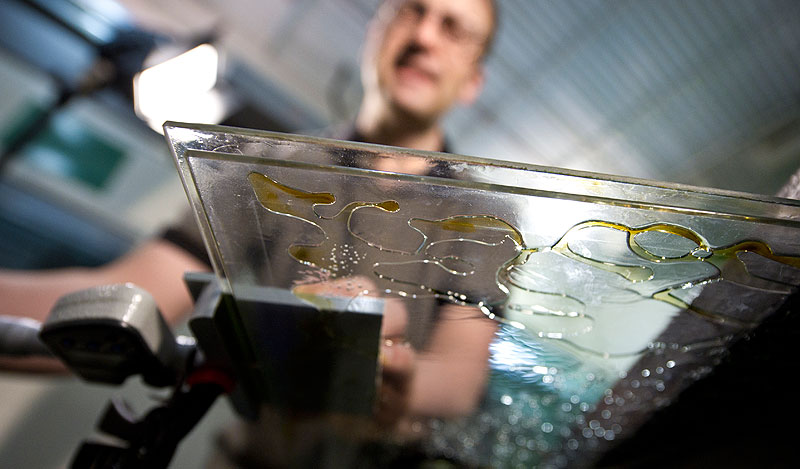
In this photo, a scientist is using a calibrating instrument to measure the distance that one glass panel has separated from another. Between the glass panels, a glue-like substance has turned to liquid and is oozing yellow.Enlarge image
Working in his lab at the NREL Outdoor Test Facility, NREL scientist Michael Kempe measures the "creep" of the top and bottom glass of a solar module, testing the encapsulant and demonstrating how enough stress can produce a spectacular failure.
Credit: Dennis Schroeder
During 30 years on a rooftop, a solar panel gets bombarded by UV rays, soaked by rain, buffeted by wind, pounded by hail.
How well it stands up to that beating is a crucial factor in setting the warranties of solar modules — and in convincing the public that solar energy can be counted on like the sun rising in the east.
The U.S. Department of Energy's (DOE) National Renewable Energy Laboratory (NREL) plays a crucial role in improving the reliability of the photovoltaic (PV) panels that are being installed on rooftops in record numbers.
NREL helps set standards for reliability and serves as a neutral third party in tests of manufacturers' new solders, edge seals, and glues. At its Golden, Colorado, campus, NREL subjects solar panels to heat, humidity, and mechanical stress to simulate conditions in Denver, Phoenix, the Philippines, and elsewhere.
In March, leading scientists and engineers in the industry gathered at NREL for the PV Module Reliability Workshop. The workshop encouraged a frank discussion of reliability problems that can plague solar power companies.
What standards are needed for the glue in the edges that seal a panel's top and bottom? How does weather affect cracking? What can be done to prevent one glass panel from creeping away from the other?
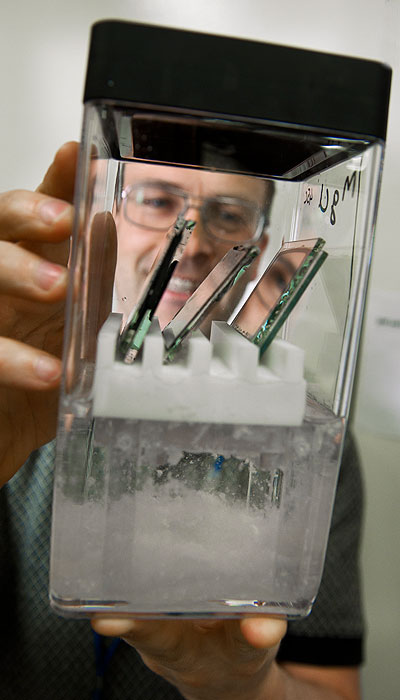
This photo shows a scientist holding a see-through container that holds three glass squares above a solution of whitish semi-solid salt.Enlarge image
NREL scientist Michael Kempe holds PV samples he is exposing to a saturated salt solution to control humidity. The samples are being tested for possible failures.
Credit: Dennis Schroeder

NREL Stresses Edge Seals to Predict Failure

Solar modules must be sealed to keep out moisture — and that's why edge seals are so crucial.
NREL scientist Michael Kempe exposes edge seals to different configurations and environments using Atlas Weather-Ometers.
On what looks like a whirling see-through geodesic dome — albeit just two feet in diameter — NREL scientists attach matchbook-sized samples that simulate the construction of PV modules to determine at what combination of UV radiation, high temperature, high humidity, and mechanical stress those samples can fail.
It's important that manufacturers not just check for single stresses. By demonstrating that a combination of two or three factors can cause a failure, NREL is helping manufacturers prepare for the worst.
"We help manufacturers to know what kind of stress to put on their samples to determine if Sample A is better than Sample B," Kempe said. "Every tiny detail, every aspect of these things has to be examined."
A typical 12-millimeter-wide edge seal should keep out moisture anywhere in the world — from Salt Lake City to Bangkok — if it maintains a good adhesion, Kempe said. And the cost is between $1 and $2 a module, whether it is a tape-style edge seal or a hot-melt extrusion.
For humidity tests, NREL uses a vacuum oven to expose samples to controlled relative humidity using saturated salt solutions: lithium chloride for low humidity; magnesium chloride for 25% to 31% humidity; sodium nitrates for higher humidity.

Testing Leads to Good News on Panel Creep

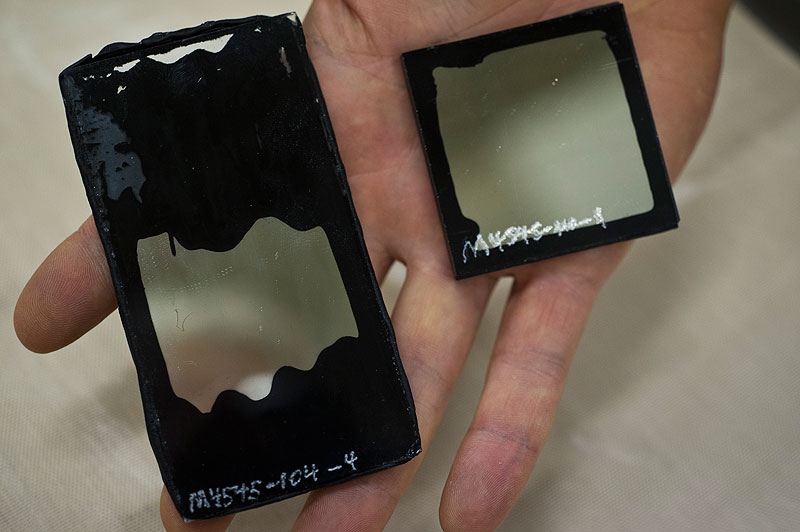
This is a close-up of a square and a rectangular sample held in a hand. The rectangular sample shows failure in the form of black globs invading the transparent center.Enlarge image
NREL scientist Michael Kempe holds PV samples he is testing for edge seals in an Atlas CI 4000 Xenon Weather-Ometer. The machine is used to give mechanical, light, heat, and humidity stress to PV samples.
Credit: Dennis Schroeder
NREL has been able to share good news with the industry.
In the case of "creep," NREL's sophisticated tests showed that the problem isn't as big as was feared.
In a solar module, two pieces of glass are adhered together with a plastic encapsulant that may be solid at one temperature but flow — or "creep" — at another temperature. If it flows during the expected lifetime of a solar module, solar panel components can be displaced, and that can cause a short, break electrical connections, or even cause fires.
The stakes are high: a one-centimeter creep can expose live wires to the elements, and that can cause arcing or other serious safety problems.
NREL's tests found that most encapsulants used today or proposed for future use do a very good job of preventing creep. But showing that failure is possible keeps manufacturers from becoming complacent.
Last summer, Kempe and his colleagues used eight different encapsulants from six manufacturers to assemble several mock and actual solar modules. The scientists then evaluated them side by side in an objective manner, and in a way that uncovered strengths and weaknesses of the various encapsulants without pointing fingers at individual companies. The industry's trust in NREL made the tests possible. "They were able to participate without the fear of being singled out," Kempe said.
The researchers put insulating materials on the test modules and deployed them in Arizona so they would reach the highest temperatures (104°C) that are likely in the field.
The only material that crept significantly in the outdoor experiments was one that was intentionally formulated improperly so that it would still melt at moderate temperatures.
"All the other plastic materials that people in the industry were considering for encapsulation were essentially OK outdoors," Kempe said. "It would only be under very extreme circumstances that you might have a problem. The standards community realized that this stumbling block was not nearly as big an issue as was suspected."

Stress, Temperature Tests Help Prevent Cell Overheating

In this close-up of a weatherization instrument, a gray spindle is in the foreground, and red and clear samples, looking like the windows on a geodesic dome, are in the background.Enlarge image
Shown here is a close-up of the inside of an Atlas CI 4000 Xenon Weather-Ometer used to test small samples of solar panels. NREL scientists apply temperature, humidity, and mechanical stress to the samples to show industry how they can fail.
Credit: Dennis Schroeder
NREL also works on the problem of concentrating PV cells overheating in a module. Concentrating PV uses lenses to focus more sunlight on a solar cell. The solder or epoxy that adheres the panel's glass and edges will fatigue with time because of temperature changes that happen with the weather, NREL scientist Nick Bosco said. When the attachment goes bad, heat can't escape, and the cell overheats.
NREL uses high-frequency weather data to model the changes in cell temperature for Houston, Los Angeles, Albuquerque … wherever a company wants a climate test. The data are publicly available.
The most damaging locales are those with high temperatures and partly cloudy skies. The frequent temperature changes when clouds pass by can cause extra stress. "In Golden, Colorado [site of NREL's main campus], where we get hot mornings and then clouds roll in every afternoon, that can be more damaging than in Phoenix where you don't have many clouds," Bosco said. "We're early in the process, but we're seeing easily a 20% to 40% difference between certain locations."
To test the effect of temperature cycles on the modules, NREL uses various solders and epoxies to attach pieces of the panels, and then exposes them to different temperatures at varying intervals. Researchers test thermal cycling in indoor chambers and expose modules to outside conditions, comparing the results.
"We're interested in how cracks grow in the solder as the module goes through cycles," Bosco said. "Our instruments can image the cracks on a computer, analyze them, and measure their size. We'll do that periodically, then put the module back in the chamber, do more cycles, then measure the growth rate of the cracks as a function of the number of cycles."
Bosco is working on models and experiments to determine the amount of damage the attachment will accumulate. The goal is for the indoor test chamber to accurately reflect outdoor conditions.
"The amount of damage the attachment accumulates is different for every city, and we're hoping to model that," Bosco said. "We're hoping to be able to make real-life predictions based on location." So many cycles in the chamber is equal to so many years outside. "So, a company might expect similar crack growth after so many years."
The challenge for industry is to design solar modules that are very durable and reliable, yet not overly expensive. NREL scientists and their industry counterparts agree they can meet that challenge.
"They're looking for a route to a less expensive design and architecture of a cell assembly," Bosco said. NREL is able to figure out why a solution works, not just that it does work. It can report that a change in design or materials has this or that consequence in reliability. And NREL shares that knowledge with the industry to help the technology move forward.
NREL scientists and their industry partners have learned that an accelerated test will mean different things in different locations — and that the material and architecture of the design can influence reliability dramatically. "You can certainly have an expensive bad design," Bosco said. And, of course, a good product that is incorrectly installed can fail.
As tempting as it is to accelerate the testing so that new, presumably better products can get to market sooner, testing experts know that validating a product for 20 or 30 years of useful life is complicated without comparisons to real-life durability.
So, NREL and the industry keep a poultry analogy in mind. "When you're trying to hatch an egg, you give it 25 days at about 40°C, and you get a chicken," Kempe said. "If you try to accelerate the time by accelerating the temperature, you get a boiled egg."
The results of NREL's testing will provide the technical basis for changes to reliability standards.
Today, the standards aren't robust enough to predict the overall longevity of solar panels. NREL, the PV industry, and the attendees of the PV Reliability Workshop are working toward the day when tests and standards can determine the lifetime reliability of a module.
"What can come out of this is a graded test sequence," Bosco said. "If you pass, say, Level A, it means the module is good for a lifetime in these certain locations. A stricter Level B certification will provide a similar lifetime warranty in more damaging locations."
Learn more about NREL's PV performance and reliability testing.
—Bill Scanlon


Posted originally by NREL. Please follow us on Twitter and "like" us on Facebook!
Tuesday, September 18, 2012

Sci-Fi No Longer, NREL Engineers Smart Homes


National Renewable Energy Laboratory

NREL Newsroom

Sci-Fi No Longer, NREL Engineers Smart Homes

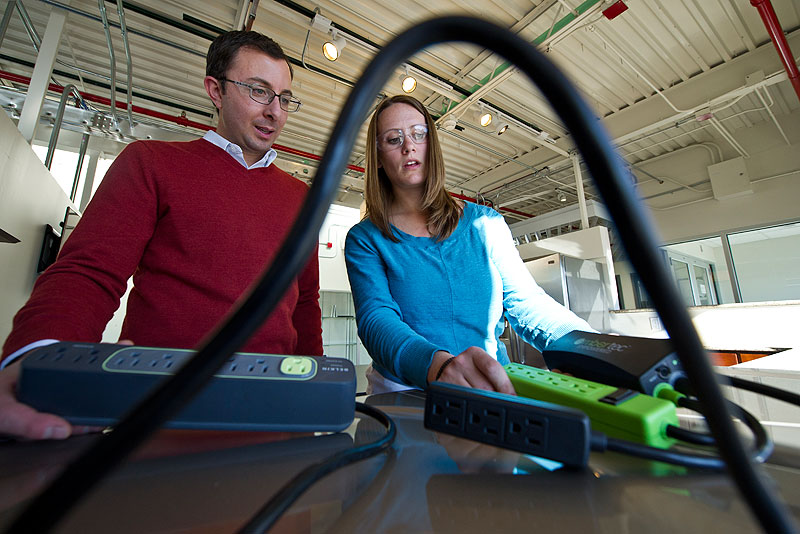
Photo of a man and woman looking at home power strips.Enlarge image
NREL engineers Dane Christensen and Bethany Sparn test advanced power strips at NREL's Automated Home Energy Management Laboratory. The lab enables researchers to study the complex interactions of appliances and other devices in connection to the energy grid.
Credit: Dennis Schroeder
Thanks to TV shows such as The Jetsons and Star Trek, many Americans grew up dreaming that homes of the future would be equipped with fantastic high-tech features. From automatic food dispensers to sliding doors, to Rosie the Robot doing the household chores, the imagined homes of the future seemed to be driven by an unlimited supply of energy.
Research engineers at the U.S. Department of Energy's (DOE) National Renewable Energy Laboratory (NREL) have a different vision for the home of the future. The team is working on a "smart" home that will communicate with the electricity grid to know when power is cheap, tell appliances when to turn on or off, and even know when renewable energy resources are available to offset peak demand.
NREL is leveraging two laboratories to make its dream home a reality — the soon-to-be-built Smart Power Laboratory, which is part of the new Energy Systems Integration Facility (ESIF), and the Automated Home Energy Management Laboratory.

Smart Power for the Next Generation

NREL's 5,300-square-foot Smart Power Laboratory will focus on two key areas: the development and testing of power electronics systems and controls, and the implementation of newer control approaches for smart energy management devices and systems. The lab will feature three power electronics test bays with sound abatement walls and a 96-square-foot walk-in fume hood for testing early prototype systems that have a higher risk of failure. There will also be four smart grid test bays capable of testing a variety of household appliances and systems.
"A part of our research in the Smart Power Laboratory will focus on the integration of distributed energy resources using power electronics; we want to develop a new generation of power electronics systems that will provide advanced functionalities to consumers and utilities, and lead to more efficient integration of renewable energy into the smarter electric grid," NREL Senior Research Engineer Sudipta Chakraborty said. "The present work being done at NREL is on a smaller scale because we are constrained by the size and infrastructure of our current lab. The lab in ESIF will greatly enhance our ability to develop and test bigger power electronics systems."
The Smart Power Laboratory will allow NREL to perform equipment testing for industry. For example, if a manufacturer builds a new inverter, it can be tested and validated at NREL before the manufacturer takes the system for certification. This will greatly reduce the risk of failure for the manufacturer during the certification testing.
"We've found that a large number of manufacturers don't have all of the necessary equipment to do the required testing — like having a grid simulator to see how their inverter behaves if there is a disturbance in the grid frequency," Chakraborty said. "ESIF will have equipment that can test this type of power electronics system, and thanks to our large grid simulators, load banks, and DC sources, connected through the Research Electrical Distribution Bus (REDB), we can be a test bed for even bigger inverters — which is the current trend in the market."
In addition to the power electronics research, the Smart Power Laboratory's smart grid test bays will be used to develop newer grid-monitoring equipment and to test smart appliances and home automation, energy management, and heating, ventilating, and air conditioning (HVAC) systems. The hardware-in-the-loop system and the capability of real-time control of the megawatt-scale power equipment will enable NREL to simulate integrated system responses such as household loads and generation as seen by the utility, and will ultimately lead to the development of better energy management algorithms.
"People are really looking at the whole integration of these energy systems," Chakraborty said. "At the residential level, you'll have your house with a photovoltaic system on the roof, with smart appliances inside, and we'll look at the data to see how those systems work together. The utility companies are interested in seeing how they can control those appliances to offset loads and make the peak power demands more stable. To do that, all of these pieces have to work together, which they don't do today."

The Home of the Future

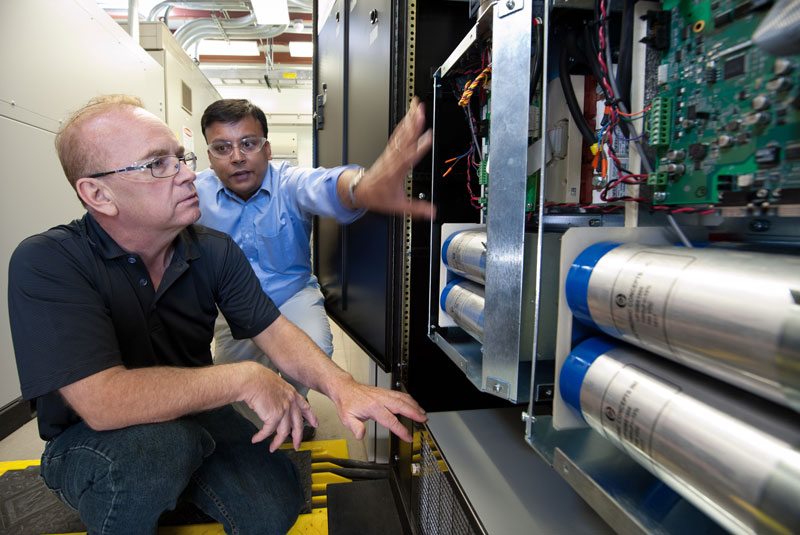
Photo of a two men looking at a power block. Enlarge image
NREL engineers Sudipta Chakraborty and Bill Kramer examine the design of the power block at an NREL lab. Along with an industrial partner, NREL engineers have developed the power block for renewable and distributed energy applications.
Credit: Dennis Schroeder
To help figure out how those pieces must work together inside a home, NREL has built the Automated Home Energy Management (AHEM) LaboratoryPDF as part of NREL's advanced residential buildings research.
We are very cognizant of the fact that every home is part of a larger energy system," NREL Senior Engineer Dane Christensen said. "We've modeled the AHEM Lab around a real home, with the same plugs, panels, and appliances. The idea is that eventually our appliances and homes are going to be able to 'talk' to the grid. We are trying to figure out how demands from the grid and the dynamics of residential energy can be coordinated."
NREL researchers have found that power is viewed differently from either side of the grid. The homeowner sees that power is always available, at a uniform cost, so there is little motivation to save power during high-demand times and then use power later when it is less constrained. Currently, it doesn't matter to homeowners if they use a clothes dryer while they bake a cake, watch TV, and have all the lights turned on in their house. But, for the grid, that kind of behavior has a huge impact, especially during summer months when air-conditioning is added to the demand mix. Today, utilities have no way to mitigate that power consumption; they simply have to generate and deliver more power.
"There has to be something in the home to receive communications about energy availability and use built-in intelligence to act on it — especially when people aren't home to do it," Christensen said. "Just like in cars, you have systems that will automatically brake for you, or protect you. In the home, the only thing automated right now is probably your thermostat."
According to Christensen, the goal is to have communications coming into the home from the utility that include pricing, requests to conserve energy, and rebates to homeowners who can act quickly to reduce power when needed. Conversely, the power company could also send a signal letting homes know that it is OK to go ahead and do laundry while cooking dinner, because there is more power available.
"We're working on building systems for homes that can take the information from the utility, along with input from the homeowner, and manage the home's energy to satisfy both the homeowner and the utility," Christensen added. "The homeowner will still be in control, with built-in overrides and the ability to change settings. But we also want to help the utility meet its needs and keep costs down, while maintaining comfort."

Making it Work for the Long Term

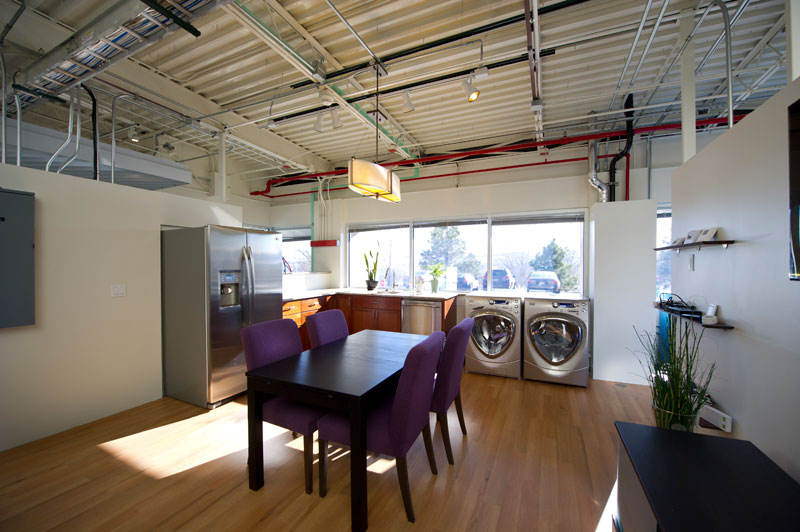
Photo of home appliances in a laboratory setting. Enlarge image
The Automated Home Energy Management Laboratory, housed in the Thermal Test Facility on NREL's main campus, incorporates all major and minor residential energy loads into a robust test bed that supports the evaluation of any type of residential automation, sensor, or energy management product in a realistic context.
Credit: Dennis Schroeder
Home energy management is a critical area for the DOE Building America program to reach its long-term goals of at least 50 percent energy savings for new construction and 40 percent savings over the minimum code for building retrofits.
Building America is the flagship program for residential research within the Building Technologies Program at DOE. The goal is to make energy efficiency cost effective for residential buildings; NREL is the technology lead and manager for the program.
"Work we did seven years ago is now being adopted into the current energy codes," Christensen said. "We are ahead of industry because it takes time for results of our research to make their way to the consumer. From where we sit right now, it looks like there is a big challenge in getting beyond the 50 percent energy savings for new home construction and 40 to 50 percent savings in retrofits, without home energy management technology in place.
"The technology created and tested at NREL's Smart Power Lab or Automated Home Energy Management Lab will enable those home-energy puzzle pieces to fall into place — helping people turn the lights off when nobody is at home, helping people adjust their thermostat when they are not at home, helping people understand that energy is expensive at a particular time of day so they can avoid running an energy-intensive appliance until power is less expensive — all of that helps save energy and costs across the board."
—Heather Lammers


Posted originally by NREL. Please follow us on Twitter and "like" us on Facebook!
Thursday, September 13, 2012

Fast Cars and Science Thrill Colorado Students - NREL


National Renewable Energy Laboratory

NREL Newsroom

Fast Cars and Science Thrill Colorado Students

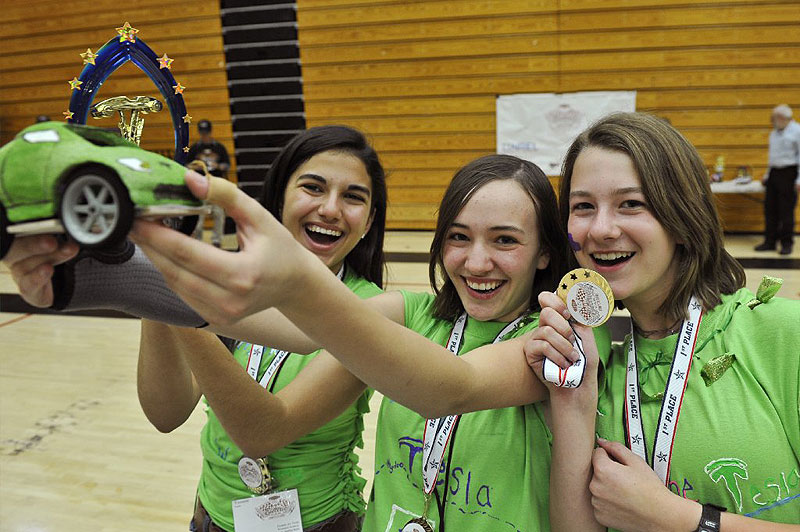
In this  photo, three eighth-grade girls in green T-shirts beam as they hold up a green  car that is about eight inches long.Enlarge image
Yasmine Lamé, Naia Tenerowicz, and Grace Simpson of Woodlands Academy in Castle Rock celebrate winning first place in design for hydrogen fuel cell cars at NREL's Junior Solar Sprint, Hydrogen Fuel Cell, and Lithium Ion Battery car competitions, held at Dakota Ridge High School in Littleton, Colorado, on May 12, 2012.
Credit: Dennis Schroeder
The buzz inside Dakota Ridge High School's gym on Saturday was palpable, the conversations ranging from whispers to shrieks.
Indy-500-style checkered flags, high-tech neoprene rubber tracks, and, of course, sponsor decals graced the site of the Junior Solar Sprint, Hydrogen Fuel Cell, and Lithium Ion Battery car competitions for Colorado middle schoolers.
Forty-five seconds before start time, seventh-grade boys raced to the repair table to solder metal parts together. Minutes after a time trial, eighth-grade girls had tweaked their designs and were ready for another heat, determined to shave a few seconds off their best time.
Parents smiled on the outside, butterflies churning on the inside. Coaches rounded up their teams; team members scattered to plot strategy or climb the wooden bleachers.
This wasn't your grandfather's mini-car race.
This was the 22nd annual electric car competition, sponsored by the U.S. Department of Energy's (DOE) National Renewable Energy Laboratory (NREL), the DOE Office of Science, Rocky Mountain Bottled Water, the Alliance for Sustainable Energy, Jefferson County Schools, Dakota Ridge High School, and the DOE Golden Field Office.
And to win, place, or just see solid improvement meant the world to participants in 104 teams from 23 Colorado schools.

Long Hours, Tangible Rewards

In  this photo, two middle-school boys are crouched down on a strip of neoprene  rubber watching their red car take off at the start of a car race. A green car  is next to it, neck and neck.Enlarge image
Austin Parks, left with hat, and Zach Schwarz, second from right, of Estes Park Middle School race in the hydrogen fuel cell division.
Credit: Dennis Schroeder
Cradling her hydrogen-powered model car like it was a baby chick, Naia Tenerowicz, 13, beamed in delight Saturday afternoon.
Her team's car, "Tommy the Tesla," had just finished first in a time trial, and its shape, engineering, and overall cuteness made it a favorite for the design award.
"It's made out of floral foam, the stuff you stick fake flowers into," Naia, a student at Woodlands Academy in Castle Rock, said. "It's really powdery, and you can squish it into shape easily. We spray it with sealant and then with white and green spray paint. And by then it's elastic and rubbery and a lot tougher."
The hydrogen fuel cell cars must use the standard cell sold by Numeridian, as well as a provided motor, electrolyzer, and battery pack. The rest of the design — chassis, wheels, shape, etc. — is up to the teammates, but the finished car can't be more than 20 centimeters wide or 40 centimeters in length. And to win a speed trophy, it had better get down the 10-meter track in about five seconds.
The solar-powered cars must use one of two designated solar panels, must be less than a foot wide and two feet long, and must be ready to switch to AA batteries on a cloudy day — like Saturday. The cars race 20 meters down the neoprene track, hooked via eyelet to a taut guide wire to stay in a straight line.

Lithium-Ion Makes its Debut

Photo  of a boy crouched down at the blue-striped starting line, holding the back  wheels of his car, while a 20-ounce water bottle sits upright on the car's  chassis.Enlarge image
Todd Bramblett of Fitzsimmons Middle School in Bailey prepares his team's lithium-ion car "The Rage" during the final eliminations of the lithium-ion battery division of the competitions. Todd's team won first place.
Credit: Dennis Schroeder
This was the first year for a third design — the lithium-ion battery. Competitors used batteries, motors, connectors, and chargers provided by Horizon Hobby. Their races were won or lost by how well a team designed the rest of the car and how ingeniously they designed the compartment to carry extra payload — a 20-ounce water bottle placed on the chassis to provide stabilizing weight.
The winners of the inaugural lithium-ion race were from Fitzsimmons Middle School in Bailey, with a car named "Rage," which blazed to the finish line in just a beat over five seconds.
"We don't really have a captain, but Todd is the bossiest," Fitzsimmons team member Jeffrey Brown said.
Todd Bramblett cheerfully agreed. "Last year we went for a straight triangle, but this year we had a contest for the design that was the fastest, and we went with this one," which looks like a Gothic knife handle, Todd said. "I guess it worked fine."
The team credits a decision to put wide rubber bands on the rear wheels for the extra traction that gave them the victory by a few hundredths of a second.
Todd ranks the win as his second-greatest life thrill, right behind the motocross time trials he won when he was younger.
Todd, Jeffrey, Brian Wismar, and Justin Boline said they're interested in football, baseball, and other sports, but that in the long run they can see future careers in engineering or physics. They worked three hours a week for several weeks on the car, which will soon find a permanent place in their school's trophy case.
Woodlands Academy had a day to remember. It finished one-two in the race for the fastest solar-powered car with "Speedy Mercury" and "Perry the Platypus."
Its "Bobby the Bottle Rocket" won a first-place trophy for design in the lithium ion category, based on technology, craftsmanship, and innovation. And "Tommy the Tesla," the car Naia Tenerowicz cradled like a baby chick, came in first in design for the hydrogen fuel cell cars.

Students Have Stars and Science in Their Eyes

In  this photo, the two girls on the left are on their knees, in green T-shirts,  raising their hands in celebration. The two girls on the right, in black  T-shirts, have different reactions, one a look of resignation, one with her  face buried in her hands.Enlarge image
Grace Simpson and Yasmine Lamé of Woodlands Academy and Anahi Portillo and Isabella Ulibarri of Estes Park Middle School react during elimination races in the hydrogen fuel cell division.
Credit: Dennis Schroeder
Naia, Grace Simpson, and Yasmine Lamé said they probably put in 100 hours on "Tommy."
Asked if this was their only interest, the trio laughed and said in unison, "We do everything."
"Legos, robotics, and all three of us were in theater," Yasmine said.
If they had to choose between an Academy Award for Best Actress and a Nobel Prize in Physics?
"Nobel Prize in Physics," Yasmine and Grace said without hesitation.
"Best Actress, I'm not going to lie," Naia said, laughing.

Wait 'Til Next Year

After the races and the awards, teams gathered their cars and their parts. Parents put arms on shoulders and said, "You'll do better next year," and "Are you kidding? You did great."
With the tracks rolled up and stored for the 2013 competitions, race starter David Ginley, a world-renowned scientist from NREL, took time to reflect.
"It was great. I think we're changing lives," Ginley, who has won five R&D 100 Awards for scientific innovation, said. "High school is sometimes too late; elementary school is too early. But right now, when they're in sixth, seventh, and eighth grades, something like this can really provide a spark.
"I've been doing this long enough that I've seen kids who've participated in these races, gone on to get internships at NREL during college, then come back as post-docs, making a career of it," he said. "It's very gratifying."
Learn more about NREL's education programs.
— Bill Scanlon


Posted originally by NREL. Please follow us on Twitter and "like" us on Facebook!
Tuesday, August 14, 2012

The Open PV Project: NREL


Stumbled across this amazing PV project by NREL a few days ago. Herre is a little bit about it and how it can help you! Check it out.


The Project

The Open PV Project is a collaborative effort between government, industry, and the public that is compiling a comprehensive database of photovoltaic (PV) installation data for the United States. Data for the project are voluntarily contributed from a variety of sources including utilities, installers, and the general public. The data collected is actively maintained by the contributors and are always changing to provide an evolving, up-to-date snapshot of the US solar power market.

Data Collection

The Open PV Project is collecting data from any willing contributor of available information. NREL has "seeded" the Open PV database by requesting data from most state run incentive programs, large utilities, and other organizations. This initial data collection has provided a solid base of data for the project to launch from and it is our hope that the database will continue to grow through contributions from the PV community and anyone interested in understanding PV market dynamics in the US.

Data Quality

Determining the quality of incoming data is dependent upon who is submitting the data to the project. This means that data coming from users associated with a particular organization may be "trusted" more than data from other unknown users. Each registered user is assigned a default "score" based on their organizational affiliation. This score is highest for Government users (State, Federal, etc.) because such users are often involved with incentive programs that have a defined data collection process in place. Second are utility and PV installers (and others in the PV industry), and so on. All users who contribute data to the project have the ability to gain a "project reputation" that can impact the score of the data they contribute.

Validation

Data validation occurs on each record in the database on a regular basis. The database is continually analyzed for corrupt records, bad or invalid data, and outliers such as an abnormal cost to watt ratio. Records found to contain questionable data are flagged and are dealt with on a case by case basis by a member of the Open PV Team.

Duplication

Understanding duplication is one of the ways that individual records are validated. In a publicly contributed database, it is imperative to anticipate the submission of duplicate records. When duplicate records are detected, they are added to an install specific list of duplicates and the data provided are aggregated into "summary records" of their respective installs. Identifying duplicate records helps validate PV installs in the database. The more a PV installation is duplicated in the database, the more trust the project places on the data for that installation.

Data Fields

Required Fields

The Open PV Project is designed to be able to store nearly any type of information pertaining to PV installations. In order to provide the primary statistics from the database we have identified 4 data fields that are required of each PV install added to the project. These four fields are:
  • Date Installed (Completion date or interconnection date)
  • Size/Capacity of the PV Installation (in kW DC)
  • Location (Zipcode or Street Address)
  • Total Installed Cost (in USD, before incentives)

Additional Fields

The four required fields listed above provide the Open PV Project with the base information needed to derive several key statistics on the US PV market, including historical trends and regional comparisons. However, the design of the Open PV database is capable of storing nearly any type of data associated with PV installation, so the Open PV Team would like to encourage you to contribute any additional information you are comfortable sharing. This extra information can be extremely valuable, for example, data that contains information about who installed the PV installation can help to answer very useful questions about where certain installers are working. Information on module or inverter types can be useful in mapping efficiency and detailed financing information can be a key factor in understanding trends in overall installation cost. The Open PV Team strongly encourages you to contribute any data you feel comfortable providing, especially data you would like to see visualized in our gallery someday.


Here is a screenshot of what the homepage looks like. It is truly an amazing tool!


Please follow us on Twitter and "like" us on Facebook!