Translate

Showing posts with label SunPower. Show all posts

Thursday, September 13, 2012

Fast Cars and Science Thrill Colorado Students - NREL


National Renewable Energy Laboratory

NREL Newsroom

Fast Cars and Science Thrill Colorado Students
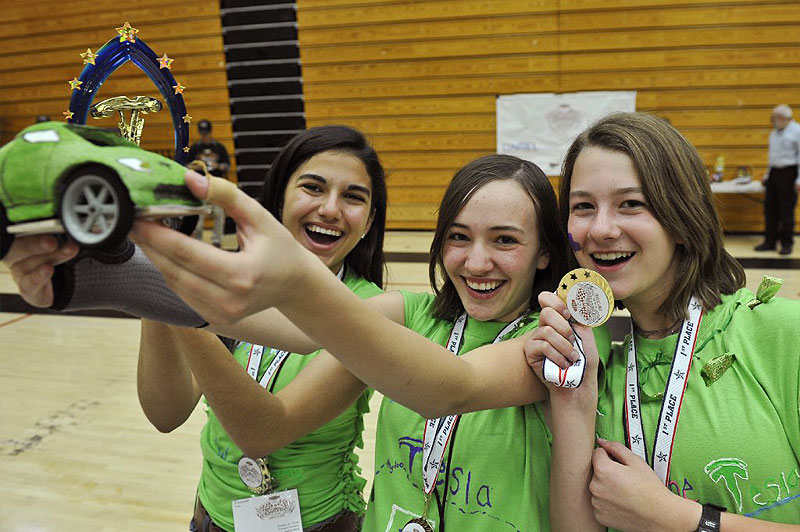
In this  photo, three eighth-grade girls in green T-shirts beam as they hold up a green  car that is about eight inches long.Enlarge image
Yasmine Lamé, Naia Tenerowicz, and Grace Simpson of Woodlands Academy in Castle Rock celebrate winning first place in design for hydrogen fuel cell cars at NREL's Junior Solar Sprint, Hydrogen Fuel Cell, and Lithium Ion Battery car competitions, held at Dakota Ridge High School in Littleton, Colorado, on May 12, 2012.
Credit: Dennis Schroeder
The buzz inside Dakota Ridge High School's gym on Saturday was palpable, the conversations ranging from whispers to shrieks.
Indy-500-style checkered flags, high-tech neoprene rubber tracks, and, of course, sponsor decals graced the site of the Junior Solar Sprint, Hydrogen Fuel Cell, and Lithium Ion Battery car competitions for Colorado middle schoolers.
Forty-five seconds before start time, seventh-grade boys raced to the repair table to solder metal parts together. Minutes after a time trial, eighth-grade girls had tweaked their designs and were ready for another heat, determined to shave a few seconds off their best time.
Parents smiled on the outside, butterflies churning on the inside. Coaches rounded up their teams; team members scattered to plot strategy or climb the wooden bleachers.
This wasn't your grandfather's mini-car race.
This was the 22nd annual electric car competition, sponsored by the U.S. Department of Energy's (DOE) National Renewable Energy Laboratory (NREL), the DOE Office of Science, Rocky Mountain Bottled Water, the Alliance for Sustainable Energy, Jefferson County Schools, Dakota Ridge High School, and the DOE Golden Field Office.
And to win, place, or just see solid improvement meant the world to participants in 104 teams from 23 Colorado schools.

Long Hours, Tangible Rewards

In  this photo, two middle-school boys are crouched down on a strip of neoprene  rubber watching their red car take off at the start of a car race. A green car  is next to it, neck and neck.Enlarge image
Austin Parks, left with hat, and Zach Schwarz, second from right, of Estes Park Middle School race in the hydrogen fuel cell division.
Credit: Dennis Schroeder
Cradling her hydrogen-powered model car like it was a baby chick, Naia Tenerowicz, 13, beamed in delight Saturday afternoon.
Her team's car, "Tommy the Tesla," had just finished first in a time trial, and its shape, engineering, and overall cuteness made it a favorite for the design award.
"It's made out of floral foam, the stuff you stick fake flowers into," Naia, a student at Woodlands Academy in Castle Rock, said. "It's really powdery, and you can squish it into shape easily. We spray it with sealant and then with white and green spray paint. And by then it's elastic and rubbery and a lot tougher."
The hydrogen fuel cell cars must use the standard cell sold by Numeridian, as well as a provided motor, electrolyzer, and battery pack. The rest of the design — chassis, wheels, shape, etc. — is up to the teammates, but the finished car can't be more than 20 centimeters wide or 40 centimeters in length. And to win a speed trophy, it had better get down the 10-meter track in about five seconds.
The solar-powered cars must use one of two designated solar panels, must be less than a foot wide and two feet long, and must be ready to switch to AA batteries on a cloudy day — like Saturday. The cars race 20 meters down the neoprene track, hooked via eyelet to a taut guide wire to stay in a straight line.

Lithium-Ion Makes its Debut
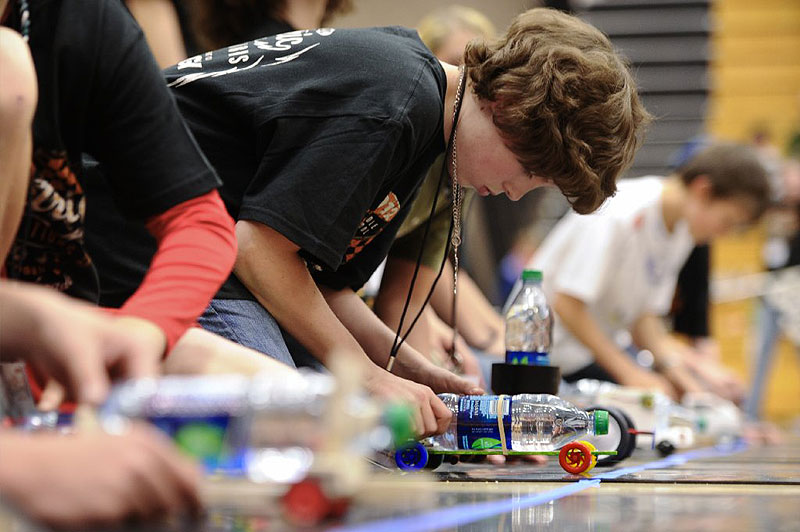
Photo  of a boy crouched down at the blue-striped starting line, holding the back  wheels of his car, while a 20-ounce water bottle sits upright on the car's  chassis.Enlarge image
Todd Bramblett of Fitzsimmons Middle School in Bailey prepares his team's lithium-ion car "The Rage" during the final eliminations of the lithium-ion battery division of the competitions. Todd's team won first place.
Credit: Dennis Schroeder
This was the first year for a third design — the lithium-ion battery. Competitors used batteries, motors, connectors, and chargers provided by Horizon Hobby. Their races were won or lost by how well a team designed the rest of the car and how ingeniously they designed the compartment to carry extra payload — a 20-ounce water bottle placed on the chassis to provide stabilizing weight.
The winners of the inaugural lithium-ion race were from Fitzsimmons Middle School in Bailey, with a car named "Rage," which blazed to the finish line in just a beat over five seconds.
"We don't really have a captain, but Todd is the bossiest," Fitzsimmons team member Jeffrey Brown said.
Todd Bramblett cheerfully agreed. "Last year we went for a straight triangle, but this year we had a contest for the design that was the fastest, and we went with this one," which looks like a Gothic knife handle, Todd said. "I guess it worked fine."
The team credits a decision to put wide rubber bands on the rear wheels for the extra traction that gave them the victory by a few hundredths of a second.
Todd ranks the win as his second-greatest life thrill, right behind the motocross time trials he won when he was younger.
Todd, Jeffrey, Brian Wismar, and Justin Boline said they're interested in football, baseball, and other sports, but that in the long run they can see future careers in engineering or physics. They worked three hours a week for several weeks on the car, which will soon find a permanent place in their school's trophy case.
Woodlands Academy had a day to remember. It finished one-two in the race for the fastest solar-powered car with "Speedy Mercury" and "Perry the Platypus."
Its "Bobby the Bottle Rocket" won a first-place trophy for design in the lithium ion category, based on technology, craftsmanship, and innovation. And "Tommy the Tesla," the car Naia Tenerowicz cradled like a baby chick, came in first in design for the hydrogen fuel cell cars.

Students Have Stars and Science in Their Eyes

In  this photo, the two girls on the left are on their knees, in green T-shirts,  raising their hands in celebration. The two girls on the right, in black  T-shirts, have different reactions, one a look of resignation, one with her  face buried in her hands.Enlarge image
Grace Simpson and Yasmine Lamé of Woodlands Academy and Anahi Portillo and Isabella Ulibarri of Estes Park Middle School react during elimination races in the hydrogen fuel cell division.
Credit: Dennis Schroeder
Naia, Grace Simpson, and Yasmine Lamé said they probably put in 100 hours on "Tommy."
Asked if this was their only interest, the trio laughed and said in unison, "We do everything."
"Legos, robotics, and all three of us were in theater," Yasmine said.
If they had to choose between an Academy Award for Best Actress and a Nobel Prize in Physics?
"Nobel Prize in Physics," Yasmine and Grace said without hesitation.
"Best Actress, I'm not going to lie," Naia said, laughing.

Wait 'Til Next Year

After the races and the awards, teams gathered their cars and their parts. Parents put arms on shoulders and said, "You'll do better next year," and "Are you kidding? You did great."
With the tracks rolled up and stored for the 2013 competitions, race starter David Ginley, a world-renowned scientist from NREL, took time to reflect.
"It was great. I think we're changing lives," Ginley, who has won five R&D 100 Awards for scientific innovation, said. "High school is sometimes too late; elementary school is too early. But right now, when they're in sixth, seventh, and eighth grades, something like this can really provide a spark.
"I've been doing this long enough that I've seen kids who've participated in these races, gone on to get internships at NREL during college, then come back as post-docs, making a career of it," he said. "It's very gratifying."
Learn more about NREL's education programs.
— Bill Scanlon


Posted originally by NREL. Please follow us on Twitter and "like" us on Facebook!

Tuesday, September 11, 2012

NREL Narrows Energy Tech Emissions Estimates


National Renewable Energy Laboratory

NREL Newsroom

NREL Narrows Energy Tech Emissions Estimates

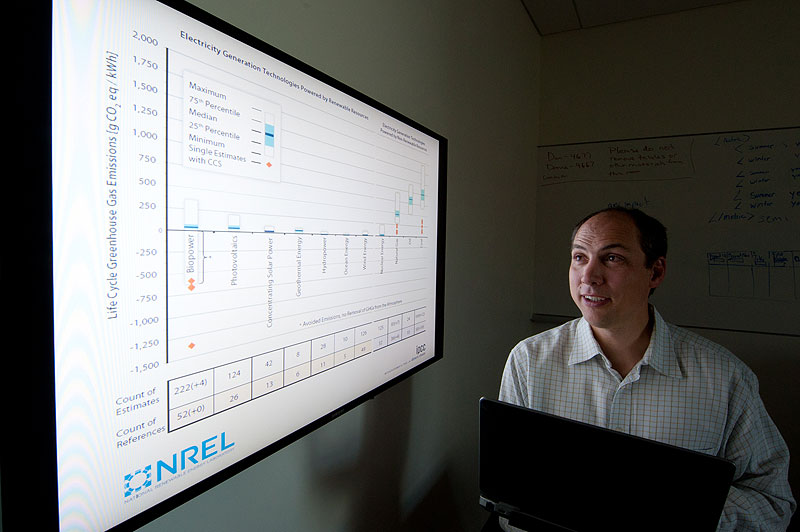
In this photo, a scientist holds a laptop, looking up at a projection that graphs greenhouse-gas emissions for various generation technologies.  Enlarge image
NREL Senior Scientist Garvin Heath works on data from the life cycle greenhouse-gas emissions study conducted by NREL's Strategic Energy Analysis Center.
Credit: Dennis Schroeder
The question of which energy technologies generate the most greenhouse-gas emissions — cradle to grave — now has a more precise answer, thanks to a meta-analysis of life cycle assessment (LCA) studies done by the U.S. Department of Energy's (DOE) National Renewable Energy Laboratory (NREL).
The new, robust analysis weighed the emissions estimates per kilowatt-hour from raw materials, manufacturing, transportation, operation, and decommissioning to get the best apples-to-apples comparisons. Sure, during operation solar panels release virtually no emissions, versus the tons of greenhouse gas produced by a large coal plant. But what about the emissions generated from the manufacture of solar panels versus, say, the turbines required for coal- and wind-based energy?
NREL's LCA Harmonization Project gives decision-makers and investors more exact estimates of greenhouse-gas emissions for renewable and conventional generation, clarifying inconsistent and conflicting estimates in the published literature and reducing uncertainty.
The analysis found that from cradle to grave, coal-fired energy releases about 20 times as much greenhouse gas into the atmosphere per kilowatt-hour as solar energy. Wind and nuclear energy are on relative par with solar energy. Natural gas generation wasn't included in the final analysis but is generally assumed to emit about half as much greenhouse gas per kilowatt-hour as coal.
What's more, the "study of studies" narrowed the huge ranges of estimates sometimes as much as 90 percent, presenting a more reliable look at the likely greenhouse-gas emissions from different technologies.

Decision-Makers Need Environmental Costs Before Giving Go-Ahead

In this photo, rows of angled, bluish solar modules dominate the foreground, while a large, white wind turbine looms in the back under a blue, partly cloudy sky.Enlarge image
A multi-megawatt wind turbine and 1-megawatt PV field work together to produce energy at NREL's National Wind Technology Center (NWTC). The turbine can produce energy at night and on cloudy days, and the PV field can produce energy during days with no wind.
Credit: Dennis Schroeder
Lifetime greenhouse-gas emissions are an increasing concern for lawmakers and investors who must weigh the merits of a new coal-fired plant versus, say, a wind farm, and need to know not just the relative dollar costs but also the potential harm or benefits to the environment.
Until recently, emissions estimates ranged wildly, sometimes because vested interests had a stake in demonstrating that a certain technology's emissions were high or low. For instance, if decommissioning costs aren't included in a total-emissions estimate for nuclear energy or natural gas, those studies give artificially low figures.
NREL was seeing surprisingly high emissions numbers for concentrating solar power (CSP) plants, but deeper digging found that many studies combined the numbers from both CSP and natural gas when a utility used combustion of natural gas to supplement solar-energy generation. When the harmonization process allowed CSP emissions to stand on their own, the numbers plunged.
NREL looked at more than 2,000 studies across many generation technologies, applied quality controls, and greatly narrowed the range of estimates to reach reliable medians for greenhouse-gas emissions.
"This methodology allows you to arrive at a better precision, so you can say with more certainty that this is the benefit you get from using this technology rather than that technology," said NREL Senior Scientist Garvin Heath, who led the project. "Anyone who wants a true comparison of the greenhouse-gas costs should benefit from this."
Heath noted that today's decisions on new plants will still have ramifications decades from now. Owners and investors will need to know about greenhouse-gas emissions and their possible effect on the bottom line, while policy-makers need to know the long-term implications of greenhouse gas on climate.
Investors "need to be very forward looking," Heath said. A power plant is long lived, and its attributes and shortcomings are locked in for decades. That's why investors push for estimates of greenhouse-gas emissions before they invest.
President Obama's clean-energy standards require these estimates for each technology as a way to assign credits or discounts for building new plants. Credits, discounts, and the possible future price of carbon all figure heavily into decisions on which technology to choose.
"Analysts and decision-makers want a more robust sense or a narrower range of uncertainty to make the best decisions," Heath said. Until now, no one has tried to differentiate between low- and high-quality estimates in a comprehensive way.

Narrowing Estimates to a More Reliable Median

Heath, Technology Systems and Sustainability Analysis Group Manager Margaret Mann, and their colleagues at NREL's Strategic Energy Analysis Center discovered that there is no shortage of reports and studies estimating the greenhouse-gas emissions of various energy technologies — in fact, there are hundreds for each — but they vary greatly in quality, consistency, and validity.
Narrowing these ranges of estimates is like hooking together a 1,000-piece jigsaw puzzle, or solving a devilish crossword.
Heath and his colleagues narrowed down the various studies to those meeting minimum thresholds for quality, relevance, and transparency. They looked upstream, making sure to include the materials that go into building a solar, wind, or coal plant. They examined in detail the emissions that occur when the plant is in operation. And they looked downstream: when a plant ceases to operate, what are the environmental costs of decommissioning it?
After harmonizing 397 LCA studies of greenhouse-gas emissions from photovoltaic (PV) projects, the study found a median of 45 grams of carbon dioxide emitted per kilowatt-hour of electricity generated. Just as important, the middle 50 percent of the range (75th minus 25th percentile) of differences narrowed — from 44–73 grams before the harmonization to 39–49 grams after the harmonization.
The 45-gram median for PV contrasts with a 1,001-gram median for coal.
Nuclear energy was found to have a large range even after harmonization reduced the published range by 50 percent, to 4–110 grams. The median harmonized estimate for nuclear is 12 grams, very similar to that of many renewable technologies.
Concentrated solar power's medians were 26 grams for parabolic trough plants and 38 grams for power towers. Thanks to harmonization, the variability in estimates for CSP was reduced by 91 percent.
Thin-film solar cell technology demonstrated very low greenhouse-gas emissions: a median of 20 grams for amorphous silicon; 14 for cadmium-telluride; and 26 for copper indium gallium diselenide, with overall ranges reduced from 19–95 grams to 18–52 grams equivalent carbon dioxide per kilowatt-hour.
For wind, the harmonization study was able to narrow down the wide range of published estimates — 1.7–81 grams — to a harmonized range of 3–45 grams (a 47 percent reduction) and a more reliable median of 11 grams of carbon dioxide per kilowatt hour.

The Fine Art of Comparing Apples to Apples

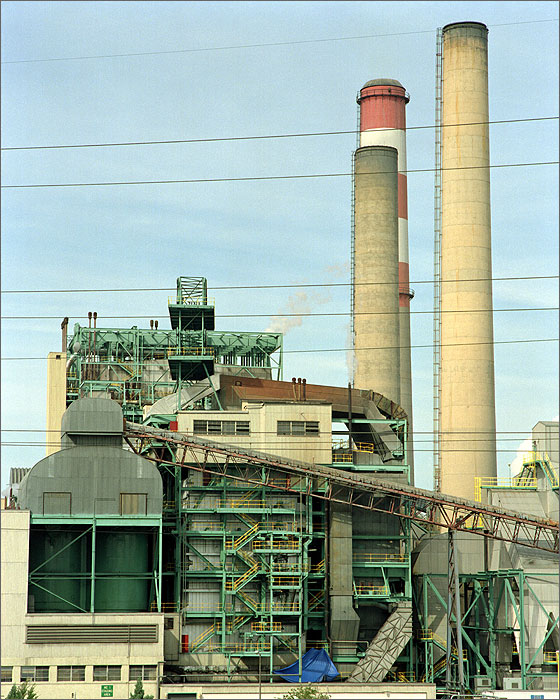
In this photo, transmission lines are in the foreground; across a body of water is a coal-powered plant featuring three tall, cylindrical chimneys.  Enlarge image
Greenhouse-gas emissions from coal-fired power plants, such as the Cherokee plant in Denver, Colorado, were compared to emissions from renewable generation in NREL's LCA Harmonization Project.
Credit: Warren Gretz
"We did a systematic review of the literature — not just peer-reviewed journals, but government reports, theses, reports from non-government organizations and private companies," Heath said. "We had to verify them all."
The team brought in experts from different disciplines, including technology experts, literature search experts, and experts in LCA.
"We screened for quality and for transparency, and we screened out the studies that were of older technologies that probably won't be going forward."
If a study didn't use sound methods, it was out. But if a good study lacked a particular variable — such as not considering decommissioning — the team used formulas to add in greenhouse-gas emissions from those activities so the otherwise-satisfactory study could be included.
"After our quantitative adjustments, each study included in the final analysis was consistent in the broad sense, if not in every detail," Heath said.
Harmonization studies help guide policy locally, statewide, and nationally. Lobbyists, lawmakers, and the cost-analysis community can all use the harmonization estimates as building blocks to make their own estimates for specific projects or to guide policy.
"They can get numbers to plug into their own models; they can use our literature to assess the climate impacts of transitioning to new forms of energy," Heath said.

Findings Appear in Special Edition of Journal of Industrial Ecology

The NREL method is being heralded as an important step forward in LCA studies that paints a clearer picture of the environmental penalties and benefits of different technologies.
NREL's findings appear in six articles and an editorial in the April special supplemental issue of the Journal of Industrial Ecology on Meta-Analysis of Life Cycle Assessments.
Also contributing to the findings were subcontractors and researchers from DOE's Brookhaven National Laboratory.
"This is great work," said Reid Lifset, editor of the Journal of Industrial Ecology. "Garvin and his crew have done something very important."

A Crucial Tool for Future Decision Making

"As a society, we need to better understand what the effects of our energy choices are," Heath said. "Greenhouse gases and climate change are a part of the discussion. As we try to envision what our future energy system will look like, we need an accurate picture of what that transition will mean."
"The scope of these syntheses is staggering and provides real insight into what can be done with the burgeoning research literature in industrial ecology," Lifset said.
Peter Crane, Yale University's dean of Forestry and Environmental Studies, agreed: "The application of meta-analysis to life cycle assessment is an important advance. Decision-makers seeking to make greener choices need a way to make sense of the information that is coming at them so quickly now. This can help."
Heath added: "If we care about stabilizing our climate, we need to look at greenhouse gases. This study assembled the best available and most robust evidence. It helps us see the state of our planet, and it can help us make better decisions going forward."
Learn more about NREL's LCA Harmonization Project and download and visualize the numerical results and bibliographies on OpenEI.org.
—Bill Scanlon

Posted originally by NREL. Please follow us on Twitter and "like" us on Facebook!
Wednesday, August 15, 2012

RenewableGlobe.com is now LIVE!


RenewableGlobe.com has officially been launched and is currently live. After a number of months of putting together this website as well as the blog that goes with it, the main portions of the site have been completed. An image of the website is seen below:


On top of completing the website, the Renewable Globe Facebook Page has grown to over 1,000 views in less than a week of launching it. A Twitter account has also been created for Renewable Globe.

Although the entire website is not complete at this time, our web and research teams are working hard to get the job done. The individual and specific pages will be complete with time detailing each type of renewable energy that we have chosen to cover at this time. Company lists will also be provided with ticker symbols and more. We appreciate everyone's support so far and will keep you posted as we will continue to grow.

Questions, comments, and/or suggestions? Please visit our Contact Us page. Thank you! 

Monday, August 6, 2012

Solar Stocks Rise High!

Renewable energy stocks fly high after positive, industry information is released!

Digitimes, Taiwan's Photonics Industry & Technology Development Association stated that Germany first-quarter installs, the largest solar panel creation customer base, rose 283% to nearly 2.0 gigawatts. China having an additional 1 gigawatts of projects in process as well and U.S. first-quarter installations grew 85% to 50 megawatts. 

After watching a majority of Solar stocks fall drastically to what looked like no bottom, they have been on fire the past few weeks with big news on earnings and new projects. These may be the stocks to watch as it seems their profits are holding strong through a dangerous economy. Read more...

Some of the big movers today include First Solar (Nasdaq: FSLR), SunPower (Nasdaq: SPWR), Ascent Solar Technologies (Nasdaq: ASTI), Yingli Green Energy (NYSE: YGE), and Trina Solar (NYSE: TSL).