Translate

Thursday, September 20, 2012

NREL Helps PV Industry Make Panels Last


National Renewable Energy Laboratory

NREL Newsroom

NREL Helps PV Industry Make Panels Last
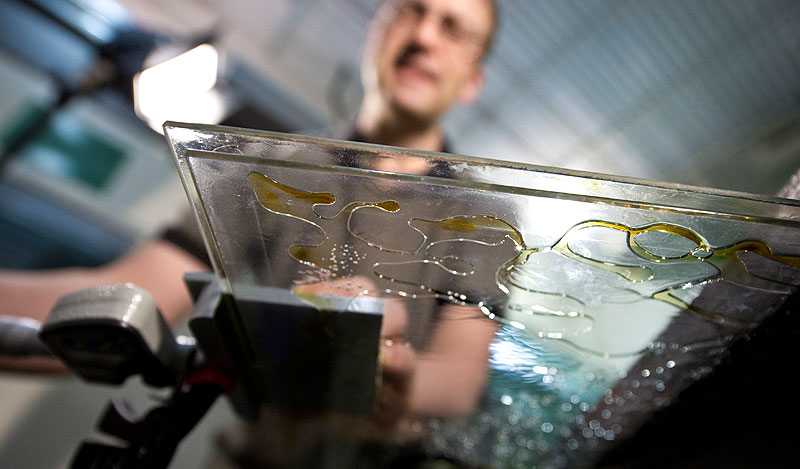
In this photo, a scientist is using a calibrating instrument to measure the distance that one glass panel has separated from another. Between the glass panels, a glue-like substance has turned to liquid and is oozing yellow.Enlarge image
Working in his lab at the NREL Outdoor Test Facility, NREL scientist Michael Kempe measures the "creep" of the top and bottom glass of a solar module, testing the encapsulant and demonstrating how enough stress can produce a spectacular failure.
Credit: Dennis Schroeder
During 30 years on a rooftop, a solar panel gets bombarded by UV rays, soaked by rain, buffeted by wind, pounded by hail.
How well it stands up to that beating is a crucial factor in setting the warranties of solar modules — and in convincing the public that solar energy can be counted on like the sun rising in the east.
The U.S. Department of Energy's (DOE) National Renewable Energy Laboratory (NREL) plays a crucial role in improving the reliability of the photovoltaic (PV) panels that are being installed on rooftops in record numbers.
NREL helps set standards for reliability and serves as a neutral third party in tests of manufacturers' new solders, edge seals, and glues. At its Golden, Colorado, campus, NREL subjects solar panels to heat, humidity, and mechanical stress to simulate conditions in Denver, Phoenix, the Philippines, and elsewhere.
In March, leading scientists and engineers in the industry gathered at NREL for the PV Module Reliability Workshop. The workshop encouraged a frank discussion of reliability problems that can plague solar power companies.
What standards are needed for the glue in the edges that seal a panel's top and bottom? How does weather affect cracking? What can be done to prevent one glass panel from creeping away from the other?
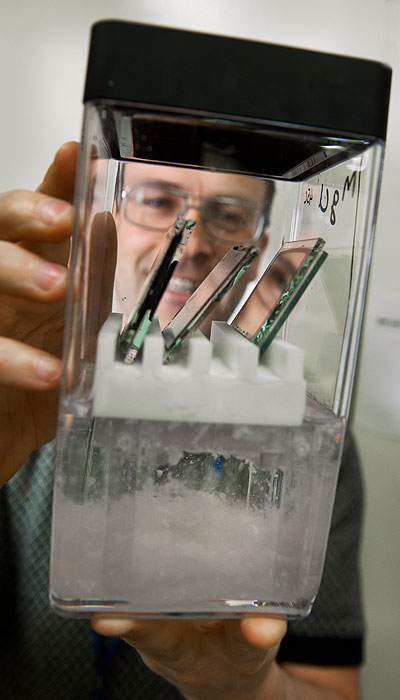
This photo shows a scientist holding a see-through container that holds three glass squares above a solution of whitish semi-solid salt.Enlarge image
NREL scientist Michael Kempe holds PV samples he is exposing to a saturated salt solution to control humidity. The samples are being tested for possible failures.
Credit: Dennis Schroeder

NREL Stresses Edge Seals to Predict Failure

Solar modules must be sealed to keep out moisture — and that's why edge seals are so crucial.
NREL scientist Michael Kempe exposes edge seals to different configurations and environments using Atlas Weather-Ometers.
On what looks like a whirling see-through geodesic dome — albeit just two feet in diameter — NREL scientists attach matchbook-sized samples that simulate the construction of PV modules to determine at what combination of UV radiation, high temperature, high humidity, and mechanical stress those samples can fail.
It's important that manufacturers not just check for single stresses. By demonstrating that a combination of two or three factors can cause a failure, NREL is helping manufacturers prepare for the worst.
"We help manufacturers to know what kind of stress to put on their samples to determine if Sample A is better than Sample B," Kempe said. "Every tiny detail, every aspect of these things has to be examined."
A typical 12-millimeter-wide edge seal should keep out moisture anywhere in the world — from Salt Lake City to Bangkok — if it maintains a good adhesion, Kempe said. And the cost is between $1 and $2 a module, whether it is a tape-style edge seal or a hot-melt extrusion.
For humidity tests, NREL uses a vacuum oven to expose samples to controlled relative humidity using saturated salt solutions: lithium chloride for low humidity; magnesium chloride for 25% to 31% humidity; sodium nitrates for higher humidity.

Testing Leads to Good News on Panel Creep
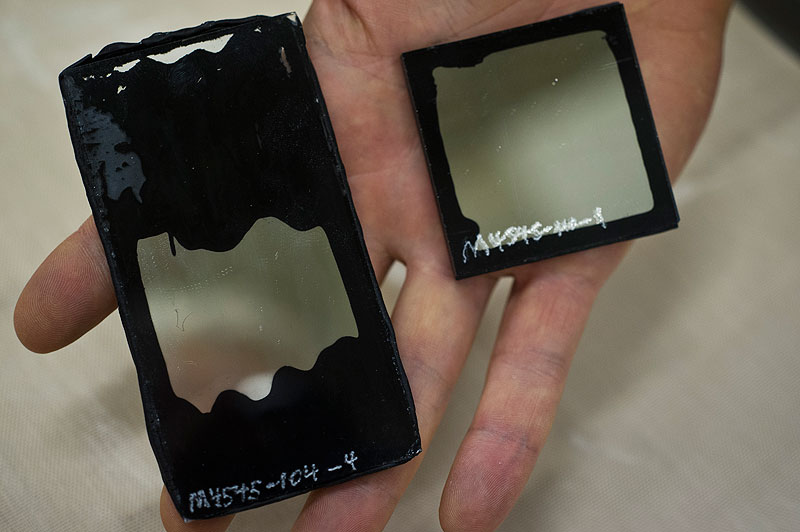
This is a close-up of a square and a rectangular sample held in a hand. The rectangular sample shows failure in the form of black globs invading the transparent center.Enlarge image
NREL scientist Michael Kempe holds PV samples he is testing for edge seals in an Atlas CI 4000 Xenon Weather-Ometer. The machine is used to give mechanical, light, heat, and humidity stress to PV samples.
Credit: Dennis Schroeder
NREL has been able to share good news with the industry.
In the case of "creep," NREL's sophisticated tests showed that the problem isn't as big as was feared.
In a solar module, two pieces of glass are adhered together with a plastic encapsulant that may be solid at one temperature but flow — or "creep" — at another temperature. If it flows during the expected lifetime of a solar module, solar panel components can be displaced, and that can cause a short, break electrical connections, or even cause fires.
The stakes are high: a one-centimeter creep can expose live wires to the elements, and that can cause arcing or other serious safety problems.
NREL's tests found that most encapsulants used today or proposed for future use do a very good job of preventing creep. But showing that failure is possible keeps manufacturers from becoming complacent.
Last summer, Kempe and his colleagues used eight different encapsulants from six manufacturers to assemble several mock and actual solar modules. The scientists then evaluated them side by side in an objective manner, and in a way that uncovered strengths and weaknesses of the various encapsulants without pointing fingers at individual companies. The industry's trust in NREL made the tests possible. "They were able to participate without the fear of being singled out," Kempe said.
The researchers put insulating materials on the test modules and deployed them in Arizona so they would reach the highest temperatures (104°C) that are likely in the field.
The only material that crept significantly in the outdoor experiments was one that was intentionally formulated improperly so that it would still melt at moderate temperatures.
"All the other plastic materials that people in the industry were considering for encapsulation were essentially OK outdoors," Kempe said. "It would only be under very extreme circumstances that you might have a problem. The standards community realized that this stumbling block was not nearly as big an issue as was suspected."

Stress, Temperature Tests Help Prevent Cell Overheating

In this close-up of a weatherization instrument, a gray spindle is in the foreground, and red and clear samples, looking like the windows on a geodesic dome, are in the background.Enlarge image
Shown here is a close-up of the inside of an Atlas CI 4000 Xenon Weather-Ometer used to test small samples of solar panels. NREL scientists apply temperature, humidity, and mechanical stress to the samples to show industry how they can fail.
Credit: Dennis Schroeder
NREL also works on the problem of concentrating PV cells overheating in a module. Concentrating PV uses lenses to focus more sunlight on a solar cell. The solder or epoxy that adheres the panel's glass and edges will fatigue with time because of temperature changes that happen with the weather, NREL scientist Nick Bosco said. When the attachment goes bad, heat can't escape, and the cell overheats.
NREL uses high-frequency weather data to model the changes in cell temperature for Houston, Los Angeles, Albuquerque … wherever a company wants a climate test. The data are publicly available.
The most damaging locales are those with high temperatures and partly cloudy skies. The frequent temperature changes when clouds pass by can cause extra stress. "In Golden, Colorado [site of NREL's main campus], where we get hot mornings and then clouds roll in every afternoon, that can be more damaging than in Phoenix where you don't have many clouds," Bosco said. "We're early in the process, but we're seeing easily a 20% to 40% difference between certain locations."
To test the effect of temperature cycles on the modules, NREL uses various solders and epoxies to attach pieces of the panels, and then exposes them to different temperatures at varying intervals. Researchers test thermal cycling in indoor chambers and expose modules to outside conditions, comparing the results.
"We're interested in how cracks grow in the solder as the module goes through cycles," Bosco said. "Our instruments can image the cracks on a computer, analyze them, and measure their size. We'll do that periodically, then put the module back in the chamber, do more cycles, then measure the growth rate of the cracks as a function of the number of cycles."
Bosco is working on models and experiments to determine the amount of damage the attachment will accumulate. The goal is for the indoor test chamber to accurately reflect outdoor conditions.
"The amount of damage the attachment accumulates is different for every city, and we're hoping to model that," Bosco said. "We're hoping to be able to make real-life predictions based on location." So many cycles in the chamber is equal to so many years outside. "So, a company might expect similar crack growth after so many years."
The challenge for industry is to design solar modules that are very durable and reliable, yet not overly expensive. NREL scientists and their industry counterparts agree they can meet that challenge.
"They're looking for a route to a less expensive design and architecture of a cell assembly," Bosco said. NREL is able to figure out why a solution works, not just that it does work. It can report that a change in design or materials has this or that consequence in reliability. And NREL shares that knowledge with the industry to help the technology move forward.
NREL scientists and their industry partners have learned that an accelerated test will mean different things in different locations — and that the material and architecture of the design can influence reliability dramatically. "You can certainly have an expensive bad design," Bosco said. And, of course, a good product that is incorrectly installed can fail.
As tempting as it is to accelerate the testing so that new, presumably better products can get to market sooner, testing experts know that validating a product for 20 or 30 years of useful life is complicated without comparisons to real-life durability.
So, NREL and the industry keep a poultry analogy in mind. "When you're trying to hatch an egg, you give it 25 days at about 40°C, and you get a chicken," Kempe said. "If you try to accelerate the time by accelerating the temperature, you get a boiled egg."
The results of NREL's testing will provide the technical basis for changes to reliability standards.
Today, the standards aren't robust enough to predict the overall longevity of solar panels. NREL, the PV industry, and the attendees of the PV Reliability Workshop are working toward the day when tests and standards can determine the lifetime reliability of a module.
"What can come out of this is a graded test sequence," Bosco said. "If you pass, say, Level A, it means the module is good for a lifetime in these certain locations. A stricter Level B certification will provide a similar lifetime warranty in more damaging locations."
Learn more about NREL's PV performance and reliability testing.
—Bill Scanlon


Posted originally by NREL. Please follow us on Twitter and "like" us on Facebook!

Tuesday, September 18, 2012

Sci-Fi No Longer, NREL Engineers Smart Homes


National Renewable Energy Laboratory

NREL Newsroom

Sci-Fi No Longer, NREL Engineers Smart Homes

Photo of a man and woman looking at home power strips.Enlarge image
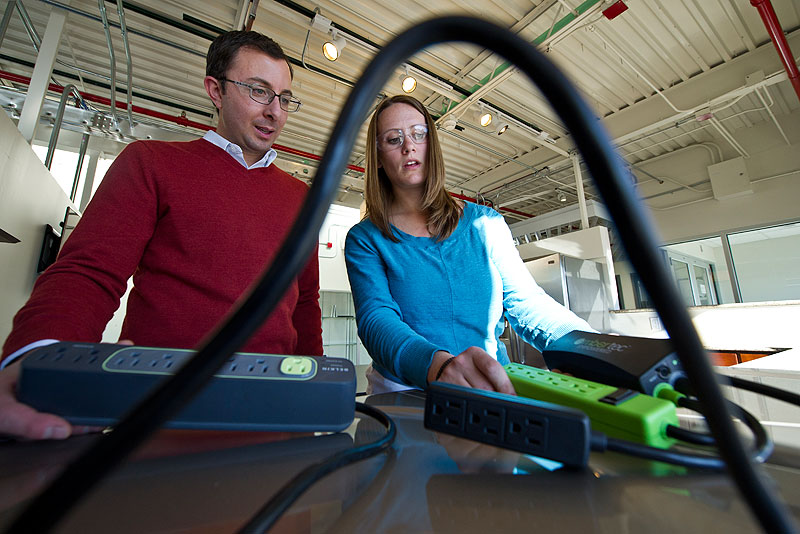
NREL engineers Dane Christensen and Bethany Sparn test advanced power strips at NREL's Automated Home Energy Management Laboratory. The lab enables researchers to study the complex interactions of appliances and other devices in connection to the energy grid.
Credit: Dennis Schroeder
Thanks to TV shows such as The Jetsons and Star Trek, many Americans grew up dreaming that homes of the future would be equipped with fantastic high-tech features. From automatic food dispensers to sliding doors, to Rosie the Robot doing the household chores, the imagined homes of the future seemed to be driven by an unlimited supply of energy.
Research engineers at the U.S. Department of Energy's (DOE) National Renewable Energy Laboratory (NREL) have a different vision for the home of the future. The team is working on a "smart" home that will communicate with the electricity grid to know when power is cheap, tell appliances when to turn on or off, and even know when renewable energy resources are available to offset peak demand.
NREL is leveraging two laboratories to make its dream home a reality — the soon-to-be-built Smart Power Laboratory, which is part of the new Energy Systems Integration Facility (ESIF), and the Automated Home Energy Management Laboratory.

Smart Power for the Next Generation

NREL's 5,300-square-foot Smart Power Laboratory will focus on two key areas: the development and testing of power electronics systems and controls, and the implementation of newer control approaches for smart energy management devices and systems. The lab will feature three power electronics test bays with sound abatement walls and a 96-square-foot walk-in fume hood for testing early prototype systems that have a higher risk of failure. There will also be four smart grid test bays capable of testing a variety of household appliances and systems.
"A part of our research in the Smart Power Laboratory will focus on the integration of distributed energy resources using power electronics; we want to develop a new generation of power electronics systems that will provide advanced functionalities to consumers and utilities, and lead to more efficient integration of renewable energy into the smarter electric grid," NREL Senior Research Engineer Sudipta Chakraborty said. "The present work being done at NREL is on a smaller scale because we are constrained by the size and infrastructure of our current lab. The lab in ESIF will greatly enhance our ability to develop and test bigger power electronics systems."
The Smart Power Laboratory will allow NREL to perform equipment testing for industry. For example, if a manufacturer builds a new inverter, it can be tested and validated at NREL before the manufacturer takes the system for certification. This will greatly reduce the risk of failure for the manufacturer during the certification testing.
"We've found that a large number of manufacturers don't have all of the necessary equipment to do the required testing — like having a grid simulator to see how their inverter behaves if there is a disturbance in the grid frequency," Chakraborty said. "ESIF will have equipment that can test this type of power electronics system, and thanks to our large grid simulators, load banks, and DC sources, connected through the Research Electrical Distribution Bus (REDB), we can be a test bed for even bigger inverters — which is the current trend in the market."
In addition to the power electronics research, the Smart Power Laboratory's smart grid test bays will be used to develop newer grid-monitoring equipment and to test smart appliances and home automation, energy management, and heating, ventilating, and air conditioning (HVAC) systems. The hardware-in-the-loop system and the capability of real-time control of the megawatt-scale power equipment will enable NREL to simulate integrated system responses such as household loads and generation as seen by the utility, and will ultimately lead to the development of better energy management algorithms.
"People are really looking at the whole integration of these energy systems," Chakraborty said. "At the residential level, you'll have your house with a photovoltaic system on the roof, with smart appliances inside, and we'll look at the data to see how those systems work together. The utility companies are interested in seeing how they can control those appliances to offset loads and make the peak power demands more stable. To do that, all of these pieces have to work together, which they don't do today."

The Home of the Future

Photo of a two men looking at a power block. Enlarge image
NREL engineers Sudipta Chakraborty and Bill Kramer examine the design of the power block at an NREL lab. Along with an industrial partner, NREL engineers have developed the power block for renewable and distributed energy applications.
Credit: Dennis Schroeder
To help figure out how those pieces must work together inside a home, NREL has built the Automated Home Energy Management (AHEM) LaboratoryPDF as part of NREL's advanced residential buildings research.
We are very cognizant of the fact that every home is part of a larger energy system," NREL Senior Engineer Dane Christensen said. "We've modeled the AHEM Lab around a real home, with the same plugs, panels, and appliances. The idea is that eventually our appliances and homes are going to be able to 'talk' to the grid. We are trying to figure out how demands from the grid and the dynamics of residential energy can be coordinated."
NREL researchers have found that power is viewed differently from either side of the grid. The homeowner sees that power is always available, at a uniform cost, so there is little motivation to save power during high-demand times and then use power later when it is less constrained. Currently, it doesn't matter to homeowners if they use a clothes dryer while they bake a cake, watch TV, and have all the lights turned on in their house. But, for the grid, that kind of behavior has a huge impact, especially during summer months when air-conditioning is added to the demand mix. Today, utilities have no way to mitigate that power consumption; they simply have to generate and deliver more power.
"There has to be something in the home to receive communications about energy availability and use built-in intelligence to act on it — especially when people aren't home to do it," Christensen said. "Just like in cars, you have systems that will automatically brake for you, or protect you. In the home, the only thing automated right now is probably your thermostat."
According to Christensen, the goal is to have communications coming into the home from the utility that include pricing, requests to conserve energy, and rebates to homeowners who can act quickly to reduce power when needed. Conversely, the power company could also send a signal letting homes know that it is OK to go ahead and do laundry while cooking dinner, because there is more power available.
"We're working on building systems for homes that can take the information from the utility, along with input from the homeowner, and manage the home's energy to satisfy both the homeowner and the utility," Christensen added. "The homeowner will still be in control, with built-in overrides and the ability to change settings. But we also want to help the utility meet its needs and keep costs down, while maintaining comfort."

Making it Work for the Long Term

Photo of home appliances in a laboratory setting. Enlarge image
The Automated Home Energy Management Laboratory, housed in the Thermal Test Facility on NREL's main campus, incorporates all major and minor residential energy loads into a robust test bed that supports the evaluation of any type of residential automation, sensor, or energy management product in a realistic context.
Credit: Dennis Schroeder
Home energy management is a critical area for the DOE Building America program to reach its long-term goals of at least 50 percent energy savings for new construction and 40 percent savings over the minimum code for building retrofits.
Building America is the flagship program for residential research within the Building Technologies Program at DOE. The goal is to make energy efficiency cost effective for residential buildings; NREL is the technology lead and manager for the program.
"Work we did seven years ago is now being adopted into the current energy codes," Christensen said. "We are ahead of industry because it takes time for results of our research to make their way to the consumer. From where we sit right now, it looks like there is a big challenge in getting beyond the 50 percent energy savings for new home construction and 40 to 50 percent savings in retrofits, without home energy management technology in place.
"The technology created and tested at NREL's Smart Power Lab or Automated Home Energy Management Lab will enable those home-energy puzzle pieces to fall into place — helping people turn the lights off when nobody is at home, helping people adjust their thermostat when they are not at home, helping people understand that energy is expensive at a particular time of day so they can avoid running an energy-intensive appliance until power is less expensive — all of that helps save energy and costs across the board."
—Heather Lammers


Posted originally by NREL. Please follow us on Twitter and "like" us on Facebook!

Thursday, September 13, 2012

Fast Cars and Science Thrill Colorado Students - NREL


National Renewable Energy Laboratory

NREL Newsroom

Fast Cars and Science Thrill Colorado Students

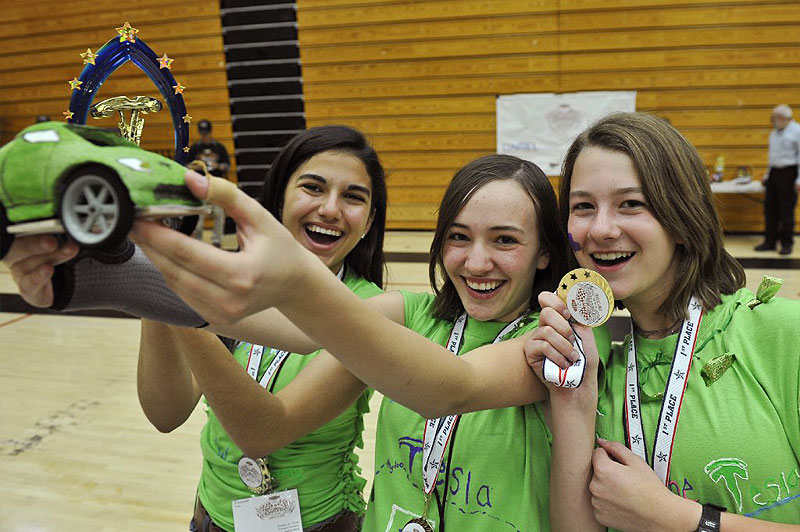
In this  photo, three eighth-grade girls in green T-shirts beam as they hold up a green  car that is about eight inches long.Enlarge image
Yasmine Lamé, Naia Tenerowicz, and Grace Simpson of Woodlands Academy in Castle Rock celebrate winning first place in design for hydrogen fuel cell cars at NREL's Junior Solar Sprint, Hydrogen Fuel Cell, and Lithium Ion Battery car competitions, held at Dakota Ridge High School in Littleton, Colorado, on May 12, 2012.
Credit: Dennis Schroeder
The buzz inside Dakota Ridge High School's gym on Saturday was palpable, the conversations ranging from whispers to shrieks.
Indy-500-style checkered flags, high-tech neoprene rubber tracks, and, of course, sponsor decals graced the site of the Junior Solar Sprint, Hydrogen Fuel Cell, and Lithium Ion Battery car competitions for Colorado middle schoolers.
Forty-five seconds before start time, seventh-grade boys raced to the repair table to solder metal parts together. Minutes after a time trial, eighth-grade girls had tweaked their designs and were ready for another heat, determined to shave a few seconds off their best time.
Parents smiled on the outside, butterflies churning on the inside. Coaches rounded up their teams; team members scattered to plot strategy or climb the wooden bleachers.
This wasn't your grandfather's mini-car race.
This was the 22nd annual electric car competition, sponsored by the U.S. Department of Energy's (DOE) National Renewable Energy Laboratory (NREL), the DOE Office of Science, Rocky Mountain Bottled Water, the Alliance for Sustainable Energy, Jefferson County Schools, Dakota Ridge High School, and the DOE Golden Field Office.
And to win, place, or just see solid improvement meant the world to participants in 104 teams from 23 Colorado schools.

Long Hours, Tangible Rewards

In  this photo, two middle-school boys are crouched down on a strip of neoprene  rubber watching their red car take off at the start of a car race. A green car  is next to it, neck and neck.Enlarge image
Austin Parks, left with hat, and Zach Schwarz, second from right, of Estes Park Middle School race in the hydrogen fuel cell division.
Credit: Dennis Schroeder
Cradling her hydrogen-powered model car like it was a baby chick, Naia Tenerowicz, 13, beamed in delight Saturday afternoon.
Her team's car, "Tommy the Tesla," had just finished first in a time trial, and its shape, engineering, and overall cuteness made it a favorite for the design award.
"It's made out of floral foam, the stuff you stick fake flowers into," Naia, a student at Woodlands Academy in Castle Rock, said. "It's really powdery, and you can squish it into shape easily. We spray it with sealant and then with white and green spray paint. And by then it's elastic and rubbery and a lot tougher."
The hydrogen fuel cell cars must use the standard cell sold by Numeridian, as well as a provided motor, electrolyzer, and battery pack. The rest of the design — chassis, wheels, shape, etc. — is up to the teammates, but the finished car can't be more than 20 centimeters wide or 40 centimeters in length. And to win a speed trophy, it had better get down the 10-meter track in about five seconds.
The solar-powered cars must use one of two designated solar panels, must be less than a foot wide and two feet long, and must be ready to switch to AA batteries on a cloudy day — like Saturday. The cars race 20 meters down the neoprene track, hooked via eyelet to a taut guide wire to stay in a straight line.

Lithium-Ion Makes its Debut

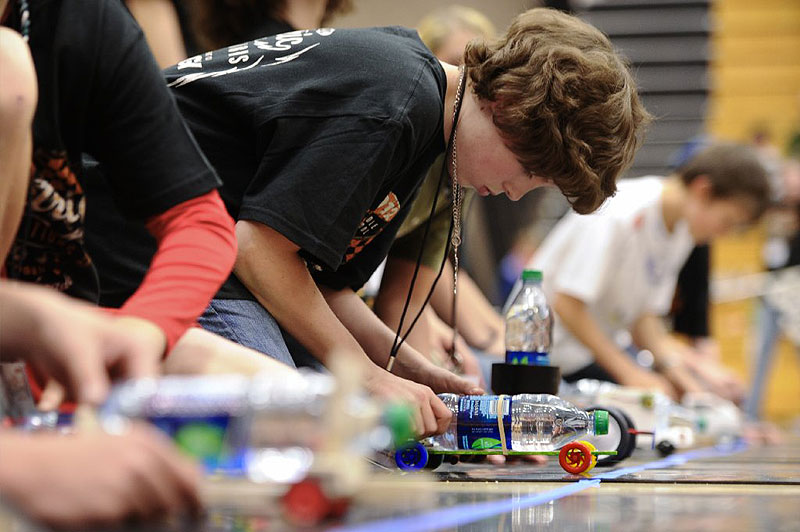
Photo  of a boy crouched down at the blue-striped starting line, holding the back  wheels of his car, while a 20-ounce water bottle sits upright on the car's  chassis.Enlarge image
Todd Bramblett of Fitzsimmons Middle School in Bailey prepares his team's lithium-ion car "The Rage" during the final eliminations of the lithium-ion battery division of the competitions. Todd's team won first place.
Credit: Dennis Schroeder
This was the first year for a third design — the lithium-ion battery. Competitors used batteries, motors, connectors, and chargers provided by Horizon Hobby. Their races were won or lost by how well a team designed the rest of the car and how ingeniously they designed the compartment to carry extra payload — a 20-ounce water bottle placed on the chassis to provide stabilizing weight.
The winners of the inaugural lithium-ion race were from Fitzsimmons Middle School in Bailey, with a car named "Rage," which blazed to the finish line in just a beat over five seconds.
"We don't really have a captain, but Todd is the bossiest," Fitzsimmons team member Jeffrey Brown said.
Todd Bramblett cheerfully agreed. "Last year we went for a straight triangle, but this year we had a contest for the design that was the fastest, and we went with this one," which looks like a Gothic knife handle, Todd said. "I guess it worked fine."
The team credits a decision to put wide rubber bands on the rear wheels for the extra traction that gave them the victory by a few hundredths of a second.
Todd ranks the win as his second-greatest life thrill, right behind the motocross time trials he won when he was younger.
Todd, Jeffrey, Brian Wismar, and Justin Boline said they're interested in football, baseball, and other sports, but that in the long run they can see future careers in engineering or physics. They worked three hours a week for several weeks on the car, which will soon find a permanent place in their school's trophy case.
Woodlands Academy had a day to remember. It finished one-two in the race for the fastest solar-powered car with "Speedy Mercury" and "Perry the Platypus."
Its "Bobby the Bottle Rocket" won a first-place trophy for design in the lithium ion category, based on technology, craftsmanship, and innovation. And "Tommy the Tesla," the car Naia Tenerowicz cradled like a baby chick, came in first in design for the hydrogen fuel cell cars.

Students Have Stars and Science in Their Eyes

In  this photo, the two girls on the left are on their knees, in green T-shirts,  raising their hands in celebration. The two girls on the right, in black  T-shirts, have different reactions, one a look of resignation, one with her  face buried in her hands.Enlarge image
Grace Simpson and Yasmine Lamé of Woodlands Academy and Anahi Portillo and Isabella Ulibarri of Estes Park Middle School react during elimination races in the hydrogen fuel cell division.
Credit: Dennis Schroeder
Naia, Grace Simpson, and Yasmine Lamé said they probably put in 100 hours on "Tommy."
Asked if this was their only interest, the trio laughed and said in unison, "We do everything."
"Legos, robotics, and all three of us were in theater," Yasmine said.
If they had to choose between an Academy Award for Best Actress and a Nobel Prize in Physics?
"Nobel Prize in Physics," Yasmine and Grace said without hesitation.
"Best Actress, I'm not going to lie," Naia said, laughing.

Wait 'Til Next Year

After the races and the awards, teams gathered their cars and their parts. Parents put arms on shoulders and said, "You'll do better next year," and "Are you kidding? You did great."
With the tracks rolled up and stored for the 2013 competitions, race starter David Ginley, a world-renowned scientist from NREL, took time to reflect.
"It was great. I think we're changing lives," Ginley, who has won five R&D 100 Awards for scientific innovation, said. "High school is sometimes too late; elementary school is too early. But right now, when they're in sixth, seventh, and eighth grades, something like this can really provide a spark.
"I've been doing this long enough that I've seen kids who've participated in these races, gone on to get internships at NREL during college, then come back as post-docs, making a career of it," he said. "It's very gratifying."
Learn more about NREL's education programs.
— Bill Scanlon


Posted originally by NREL. Please follow us on Twitter and "like" us on Facebook!

Tuesday, September 11, 2012

NREL Narrows Energy Tech Emissions Estimates


National Renewable Energy Laboratory

NREL Newsroom

NREL Narrows Energy Tech Emissions Estimates

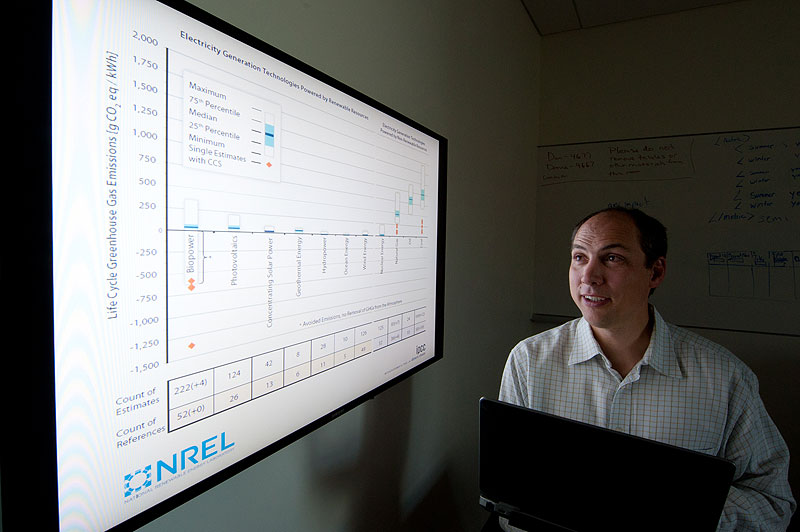
In this photo, a scientist holds a laptop, looking up at a projection that graphs greenhouse-gas emissions for various generation technologies.  Enlarge image
NREL Senior Scientist Garvin Heath works on data from the life cycle greenhouse-gas emissions study conducted by NREL's Strategic Energy Analysis Center.
Credit: Dennis Schroeder
The question of which energy technologies generate the most greenhouse-gas emissions — cradle to grave — now has a more precise answer, thanks to a meta-analysis of life cycle assessment (LCA) studies done by the U.S. Department of Energy's (DOE) National Renewable Energy Laboratory (NREL).
The new, robust analysis weighed the emissions estimates per kilowatt-hour from raw materials, manufacturing, transportation, operation, and decommissioning to get the best apples-to-apples comparisons. Sure, during operation solar panels release virtually no emissions, versus the tons of greenhouse gas produced by a large coal plant. But what about the emissions generated from the manufacture of solar panels versus, say, the turbines required for coal- and wind-based energy?
NREL's LCA Harmonization Project gives decision-makers and investors more exact estimates of greenhouse-gas emissions for renewable and conventional generation, clarifying inconsistent and conflicting estimates in the published literature and reducing uncertainty.
The analysis found that from cradle to grave, coal-fired energy releases about 20 times as much greenhouse gas into the atmosphere per kilowatt-hour as solar energy. Wind and nuclear energy are on relative par with solar energy. Natural gas generation wasn't included in the final analysis but is generally assumed to emit about half as much greenhouse gas per kilowatt-hour as coal.
What's more, the "study of studies" narrowed the huge ranges of estimates sometimes as much as 90 percent, presenting a more reliable look at the likely greenhouse-gas emissions from different technologies.

Decision-Makers Need Environmental Costs Before Giving Go-Ahead

In this photo, rows of angled, bluish solar modules dominate the foreground, while a large, white wind turbine looms in the back under a blue, partly cloudy sky.Enlarge image
A multi-megawatt wind turbine and 1-megawatt PV field work together to produce energy at NREL's National Wind Technology Center (NWTC). The turbine can produce energy at night and on cloudy days, and the PV field can produce energy during days with no wind.
Credit: Dennis Schroeder
Lifetime greenhouse-gas emissions are an increasing concern for lawmakers and investors who must weigh the merits of a new coal-fired plant versus, say, a wind farm, and need to know not just the relative dollar costs but also the potential harm or benefits to the environment.
Until recently, emissions estimates ranged wildly, sometimes because vested interests had a stake in demonstrating that a certain technology's emissions were high or low. For instance, if decommissioning costs aren't included in a total-emissions estimate for nuclear energy or natural gas, those studies give artificially low figures.
NREL was seeing surprisingly high emissions numbers for concentrating solar power (CSP) plants, but deeper digging found that many studies combined the numbers from both CSP and natural gas when a utility used combustion of natural gas to supplement solar-energy generation. When the harmonization process allowed CSP emissions to stand on their own, the numbers plunged.
NREL looked at more than 2,000 studies across many generation technologies, applied quality controls, and greatly narrowed the range of estimates to reach reliable medians for greenhouse-gas emissions.
"This methodology allows you to arrive at a better precision, so you can say with more certainty that this is the benefit you get from using this technology rather than that technology," said NREL Senior Scientist Garvin Heath, who led the project. "Anyone who wants a true comparison of the greenhouse-gas costs should benefit from this."
Heath noted that today's decisions on new plants will still have ramifications decades from now. Owners and investors will need to know about greenhouse-gas emissions and their possible effect on the bottom line, while policy-makers need to know the long-term implications of greenhouse gas on climate.
Investors "need to be very forward looking," Heath said. A power plant is long lived, and its attributes and shortcomings are locked in for decades. That's why investors push for estimates of greenhouse-gas emissions before they invest.
President Obama's clean-energy standards require these estimates for each technology as a way to assign credits or discounts for building new plants. Credits, discounts, and the possible future price of carbon all figure heavily into decisions on which technology to choose.
"Analysts and decision-makers want a more robust sense or a narrower range of uncertainty to make the best decisions," Heath said. Until now, no one has tried to differentiate between low- and high-quality estimates in a comprehensive way.

Narrowing Estimates to a More Reliable Median

Heath, Technology Systems and Sustainability Analysis Group Manager Margaret Mann, and their colleagues at NREL's Strategic Energy Analysis Center discovered that there is no shortage of reports and studies estimating the greenhouse-gas emissions of various energy technologies — in fact, there are hundreds for each — but they vary greatly in quality, consistency, and validity.
Narrowing these ranges of estimates is like hooking together a 1,000-piece jigsaw puzzle, or solving a devilish crossword.
Heath and his colleagues narrowed down the various studies to those meeting minimum thresholds for quality, relevance, and transparency. They looked upstream, making sure to include the materials that go into building a solar, wind, or coal plant. They examined in detail the emissions that occur when the plant is in operation. And they looked downstream: when a plant ceases to operate, what are the environmental costs of decommissioning it?
After harmonizing 397 LCA studies of greenhouse-gas emissions from photovoltaic (PV) projects, the study found a median of 45 grams of carbon dioxide emitted per kilowatt-hour of electricity generated. Just as important, the middle 50 percent of the range (75th minus 25th percentile) of differences narrowed — from 44–73 grams before the harmonization to 39–49 grams after the harmonization.
The 45-gram median for PV contrasts with a 1,001-gram median for coal.
Nuclear energy was found to have a large range even after harmonization reduced the published range by 50 percent, to 4–110 grams. The median harmonized estimate for nuclear is 12 grams, very similar to that of many renewable technologies.
Concentrated solar power's medians were 26 grams for parabolic trough plants and 38 grams for power towers. Thanks to harmonization, the variability in estimates for CSP was reduced by 91 percent.
Thin-film solar cell technology demonstrated very low greenhouse-gas emissions: a median of 20 grams for amorphous silicon; 14 for cadmium-telluride; and 26 for copper indium gallium diselenide, with overall ranges reduced from 19–95 grams to 18–52 grams equivalent carbon dioxide per kilowatt-hour.
For wind, the harmonization study was able to narrow down the wide range of published estimates — 1.7–81 grams — to a harmonized range of 3–45 grams (a 47 percent reduction) and a more reliable median of 11 grams of carbon dioxide per kilowatt hour.

The Fine Art of Comparing Apples to Apples

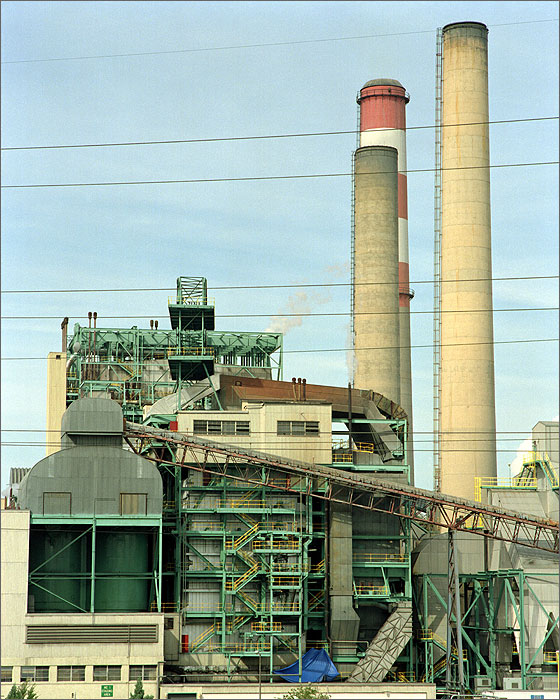
In this photo, transmission lines are in the foreground; across a body of water is a coal-powered plant featuring three tall, cylindrical chimneys.  Enlarge image
Greenhouse-gas emissions from coal-fired power plants, such as the Cherokee plant in Denver, Colorado, were compared to emissions from renewable generation in NREL's LCA Harmonization Project.
Credit: Warren Gretz
"We did a systematic review of the literature — not just peer-reviewed journals, but government reports, theses, reports from non-government organizations and private companies," Heath said. "We had to verify them all."
The team brought in experts from different disciplines, including technology experts, literature search experts, and experts in LCA.
"We screened for quality and for transparency, and we screened out the studies that were of older technologies that probably won't be going forward."
If a study didn't use sound methods, it was out. But if a good study lacked a particular variable — such as not considering decommissioning — the team used formulas to add in greenhouse-gas emissions from those activities so the otherwise-satisfactory study could be included.
"After our quantitative adjustments, each study included in the final analysis was consistent in the broad sense, if not in every detail," Heath said.
Harmonization studies help guide policy locally, statewide, and nationally. Lobbyists, lawmakers, and the cost-analysis community can all use the harmonization estimates as building blocks to make their own estimates for specific projects or to guide policy.
"They can get numbers to plug into their own models; they can use our literature to assess the climate impacts of transitioning to new forms of energy," Heath said.

Findings Appear in Special Edition of Journal of Industrial Ecology

The NREL method is being heralded as an important step forward in LCA studies that paints a clearer picture of the environmental penalties and benefits of different technologies.
NREL's findings appear in six articles and an editorial in the April special supplemental issue of the Journal of Industrial Ecology on Meta-Analysis of Life Cycle Assessments.
Also contributing to the findings were subcontractors and researchers from DOE's Brookhaven National Laboratory.
"This is great work," said Reid Lifset, editor of the Journal of Industrial Ecology. "Garvin and his crew have done something very important."

A Crucial Tool for Future Decision Making

"As a society, we need to better understand what the effects of our energy choices are," Heath said. "Greenhouse gases and climate change are a part of the discussion. As we try to envision what our future energy system will look like, we need an accurate picture of what that transition will mean."
"The scope of these syntheses is staggering and provides real insight into what can be done with the burgeoning research literature in industrial ecology," Lifset said.
Peter Crane, Yale University's dean of Forestry and Environmental Studies, agreed: "The application of meta-analysis to life cycle assessment is an important advance. Decision-makers seeking to make greener choices need a way to make sense of the information that is coming at them so quickly now. This can help."
Heath added: "If we care about stabilizing our climate, we need to look at greenhouse gases. This study assembled the best available and most robust evidence. It helps us see the state of our planet, and it can help us make better decisions going forward."
Learn more about NREL's LCA Harmonization Project and download and visualize the numerical results and bibliographies on OpenEI.org.
—Bill Scanlon

Posted originally by NREL. Please follow us on Twitter and "like" us on Facebook!
Thursday, September 6, 2012

Renewable Globe Solar and Wind Company Directory


Today marks the officially launch of both the solar and wind company Renewable Globe company database. After pushing through thousands of companies, two lists have been formed giving access to an international list of solar and wind companies. In order to access these lists please visit: Solar Companies and Wind Companies.

The lists are organized in alphabetical order as shown in the image below:


By clicking on each of the different letters, you will find yourself searching for the first letter of the first word in each company name. You will also find stock symbols and the countries each company is located in. We hope this will act as another resource for everyone as we fight to spread the word about renewable energies.

Please follow and "like" us on Twitter and Facebook


Tuesday, September 4, 2012

Energy Department Investments to Develop Lighter, Stronger Materials for Greater Vehicle Fuel Economy


WASHINGTON – As part of the Obama Administration’s all-of-the-above energy strategy to reduce the United States’ reliance on foreign oil and save drivers money at the pump, U.S. Energy Secretary Steven Chu announced today seven new projects to accelerate the development and deployment of stronger and lighter materials for the next generation of American-made cars and trucks. These projects include the development and validation of modeling tools to deliver higher performing carbon fiber composites and advanced steels, as well as research into new lightweight, high-strength alloys for energy-efficient vehicle and truck engines.
“With strong, lightweight materials we have an opportunity to dramatically increase vehicle fuel economy, while helping America maintain its competitive edge in automotive design and manufacturing,” said Secretary Chu. “Today’s investment in new lightweight materials builds on the Obama Administration’s historic fuel economy standards that are already helping drivers save money at the pump.”
The Obama Administration has taken unprecedented steps to improve the fuel efficiency of American vehicles, reaching historic agreements to improve fuel economy standards for passenger cars and light-duty trucks through Model Year 2025. These standards are expected to save consumers $1.7 trillion at the pump, or about $8,200 in costs over the lifetime of each vehicle. In fact, the initial set of standards for Model Years 2011 to 2016 is already having an impact for American families and businesses. The Energy Information Administration estimates model year 2011 cars achieved record average fuel economy at 34.4 miles per gallon, representing a 2 percent increase over 2010 model year cars.
Achieving the goals of this historic agreement will rely on innovative technologies and manufacturing that will spur economic growth and create high-quality domestic jobs in cutting edge industries across America. The projects announced today will help provide additional technologies and innovations that will enable manufacturers to continue to improve vehicle fuel efficiency beyond the regulated levels. Advanced materials are essential for boosting the fuel economy of cars and trucks while maintaining and improving safety and performance. Replacing cast iron and traditional steel components with lightweight materials – including advanced high-strength steel, magnesium, aluminum, and carbon fiber composites – allows vehicle manufacturers to include additional safety devices, integrated electronic systems and emissions control equipment on vehicles without increasing their weight. Using lighter materials also reduces a vehicle’s fuel consumption. Reducing a vehicle’s weight by just 10 percent can improve the fuel economy by 6 to 8 percent.
The new investments announced today support materials innovation in two critical areas:
Improving Carbon Fiber Composites and Advanced Steel through Computational Design
The Energy Department will award two projects to validate existing modeling tools to optimize the performance and cost-effectiveness of carbon fiber and other specialized composite materials for vehicle body, chassis and interior uses. For example, Pacific Northwest National Laboratory, based in Richland, Washington, is receiving a $1 million investment to validate carbon fiber composite models.
Additionally, the Department is investing $6 million to develop new modeling tools to advance third-generation high-strength steels. Through this project, Detroit-based United States Automotive Materials Partnership will leverage an additional $2.5 million in private investment to help create modeling tools for deploying high-strength steels for lighter passenger vehicles.
Advanced Alloy Development for Automotive and Heavy-Duty Engines
Today’s investment also includes four project that will develop lightweight, high-strength alloys for automotive and heavy duty engine blocks and cylinder heads. For instance, Caterpillar Inc, based near Peoria, Illinois, is leveraging a $3.4 million Energy Department award, as well as $1.5 million in private investment, to develop high-strength iron-based alloys to allow for higher cylinder pressures and increased engine efficiency.
Read the full list of awards HERE.
The Energy Department will provide $8 million this year for these awards, and has requested an additional $13.75 million next year, subject to congressional appropriations, to support the completion of these projects over the next two to four years.  The Department’s investments are leveraging an additional $11 million from the private sector. These projects support the Materials Genome Initiative, an ambitious effort announced by President Obama to double the speed and cut the cost of discovering, developing, and deploying new high-tech materials in the United States.
From developing stronger, safer and lighter materials for today’s automobiles, to lowering the costs of electric vehicle batteries and better combustion engines, the Energy Department has supported a range of technological advances in vehicle efficiency that has helped maintain America’s competitive edge in this global industry. More information on these investments is available HERE.
Posted originally by the Department of Energy. Please follow us on Twitter and "like" us on Facebook!